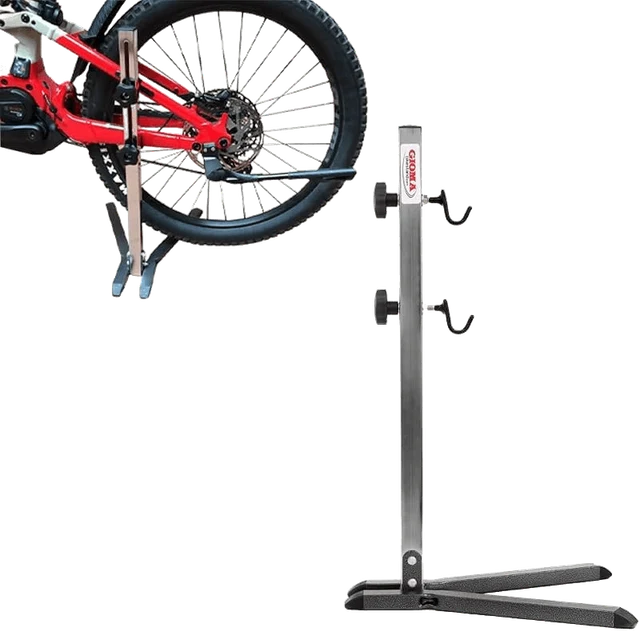
Repair stands
CXWXC montagestandaard heavy-duty
A CXWXC repair stand for the home workshop, described as heavy-duty. The bike hangs in the clamp while you work.
What you get
- CXWXC
- Repair stand
- Heavy-duty
Why a repair stand?
Anyone who has turned a bike upside down or leaned it on a wall to work on it knows the problem: it falls, the saddle scratches, the cables get in the way. With a stand the bike hangs steadily at a height where you can see and reach everything. It helps most with chain care, adjusting gears and brakes, and weighing or washing.
There are two ways to clamp the bike. On most models you clamp the seatpost or frame in a jaw on the arm. A clamp on the top tube can damage a carbon frame, so always check that your frame allows it. A carbon seatpost cannot be clamped carelessly: keep the clamp pressure low or use an aluminium post as the clamping point.
Load capacity matters. A normal home stand typically carries up to about 25 to 30 kg. An e-bike or a heavy mountain bike can exceed that. So look at the maximum weight the maker states, and count the bike and battery.
A good stand is stable enough to pull on without tipping, has a clamp that does not damage the tube and folds away for storage. If you only clean and lubricate now and then, a folding model is enough. If you work on your bike more often, a heavier workshop stand is worth more.
How repair stands compare
How the bike is held and how much it carries decides who it suits.
| Type | How it holds | Capacity | For whom |
|---|---|---|---|
| Folding home model | Clamp on seatpost or frame | Usually up to about 25 to 30 kg | Occasional maintenance |
| Sturdy workshop stand | Clamp with rotating head | Often 30 kg or more | If you often work on the bike |
| Rear wheel stand | Lifts the rear wheel | Usually light | Gear adjustment |
| Stand with fork mount | Fork and axle, wheel removed | Depends on the model | Transport and storage |
Check the maximum weight the maker states.
Choose it if
- You maintain your bikes often
- You want a sturdy stand for heavier bikes
- You maintain and repair your bike yourself, at home or in the garage.
- You want the wheels free to turn when adjusting gears or brakes.
Choose something else if
- You have little space and want a compact stand
- You ride little and have everything done by a workshop. A stand would only take up space.
- You have a carbon frame and want to clamp it on the top tube. That can damage it.
How to use a repair stand
Set the stand up firmly
Put it on a flat surface and fold the legs fully out. Check that it does not wobble.
Choose where to clamp
Clamp the seatpost or a tube the maker allows. Never clamp the middle of a carbon tube.
Hang the bike in
Open the clamp, place the bike and close it gently until it holds firmly. Do not tighten harder than needed.
Set the height
Set the bike at a height where you reach the drivetrain with a straight back. Lock the mast clamp properly.
Work, then take it out
Turn the pedals or wheel gently. When you push or pull hard, hold the bike to stop it tipping.
Good to know
- Check weight limit and clamp for carbon frames
- See whether it folds
- Never clamp a carbon frame or carbon seatpost with a lot of force. Use the post or tube the maker names.
- Check that the capacity suits your bike, including battery or bags. An overloaded stand can fall over.
- Do not loosen a bolt that needs a lot of force (such as a bottom bracket) with the bike hanging in the stand. It can tip.
- Check the clamp and hinges now and then. Wear makes the stand less stable.
Also in this category
- Relaxdays montagestandaard met gereedschapsbakje2 shops · Amazon.nl, Amazon.com.befrom €39.99
- Monzana montagestandaard, inklapbaar1 shop · bol€61.99
- Floordirekt montagestandaard tot 30 kg1 shop · Amazon.com.be€39.90
- Stilo GC215 fietsstandaard1 shop · Amazon.com.be€37.97
- Fiets reparatiestandaard voor thuis1 shop · bol€54.99
- Kesser reparatiestandaard voor fietsen1 shop · Amazon.nl€68.90