Derailleurs
Achterderailleur 7/8/9-voudig voor MTB
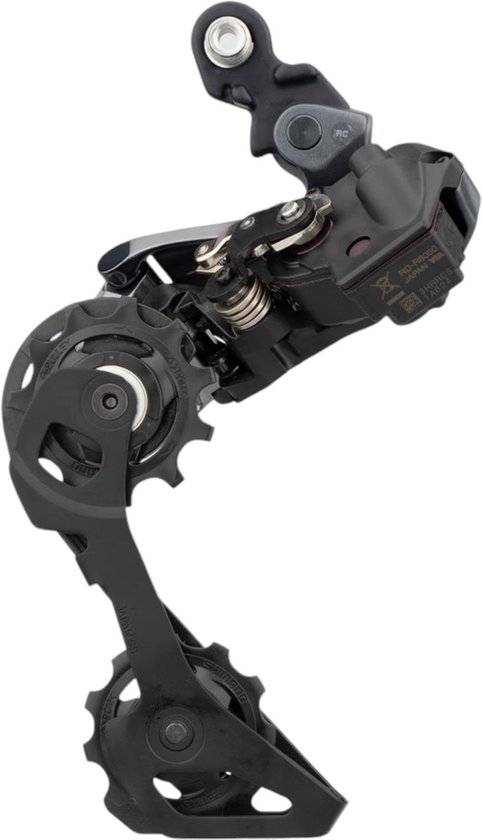
This rear derailleur is made for a mountain bike with 7, 8 or 9 speeds. It is unbranded, so the title says nothing about the series.
What you get
- Rear derailleur for MTB
- For 7, 8 or 9 speeds
- Unbranded
Why a new derailleur?
A derailleur takes a lot of punishment: knocks, mud, a crash or a stick in the spokes. A bent cage or a damaged parallelogram makes shifting vague, even after adjustment. Replacing it is then often better than continuing to adjust.
A derailleur has to match your number of sprockets and your shifter. An 11-speed derailleur works with an 11-speed shifter, and brand and type must agree. A Shimano road derailleur pulls differently from a Shimano MTB one, and SRAM and Shimano use different cable pull ratios.
Also look at cage length and capacity. A short cage (SS) suits ranges up to about 11-28 or 11-30. A medium cage (GS) takes cassettes up to about 11-34 or 11-36. A long cage goes with wide MTB cassettes. A derailleur that is too small cannot tension the chain well.
Many modern MTB derailleurs have a clutch: a brake that holds chain tension and reduces chain slap and chain drops. Electronic derailleurs shift at the push of a button and stay adjusted, but need a battery.
How the types compare
Cage length and control decide which cassette and shifter go with it.
| Type | Largest sprocket | Suits | Watch for |
|---|---|---|---|
| Short cage (SS) | Usually up to 28 or 30 teeth | Racing and fast road | Little room for wide cassettes |
| Medium cage (GS) | Usually up to 34 or 36 teeth | Gravel and recreational road | Slightly slower shifting |
| Long cage with clutch (MTB) | Up to 46 teeth and more | MTB and gravel 1x | Hangs closer to the ground |
| Electronic | Same limits as mechanical | Those who want effortless shifting | Battery to charge, own system |
Always check the maximum on the derailleur’s packaging or manual.
Choose it if
- You are replacing a broken derailleur on an older 7 to 9 speed MTB
- You want a simple replacement for a bike used for leisure rides
- Your derailleur is bent, damaged or worn so that it no longer shifts well.
- You are fitting a wider cassette and your current derailleur cannot take it.
Choose something else if
- You run 10 speeds or more: this derailleur will not suit your cassette
- Shifting is a little vague: a new cable, new housing and an adjustment often fix that.
- You do not know which shifter or cassette you have. The wrong brand or number of speeds will not work.
How to fit a rear derailleur
Check the hanger
The hanger must be straight and match your frame. A bent hanger makes even a new derailleur shift badly.
Bolt on the derailleur
Tighten the mounting bolt with a hex key to the stated figure, usually 8 to 10 Nm.
Route chain and cable
Thread the chain through the cage and size it. Clamp the cable with the chain on the smallest rear sprocket and the shifter in its lowest position.
Set the limit screws
The H and L screws keep the chain from jumping past the end sprockets. Set them so the chain runs freely.
Fine tune and test
Shift through the gears and adjust cable tension at the barrel until every step is smooth and quiet. Also check the derailleur cannot hit the spokes.
Good to know
- Check how it mounts to your frame, as hanger fittings differ
- Plan for a new cable and some adjustment
- A derailleur hanger is designed to bend so the frame survives. Replace it if it is bent. Take a spare on trips.
- Check the maximum sprocket and the capacity: a cassette that is too big can damage the wheel or the chain.
- Brand and number of speeds have to match the shifter. A mix of Shimano and SRAM usually does not work.
- Oil the pivots lightly and clean the jockey wheels now and then. Worn wheels cause noise and poorer shifting.
Also in this category
- Shimano Tourney RD-TY300 derailleur 6/7-voudig2 shops · Amazon.nl, Amazon.com.befrom €13.64
- Achterderailleur 7-11 versnellingen voor MTB1 shop · Amazon.com.be€14.99
- Achterderailleur met keramische katrol 12T1 shop · Amazon.nl€9.12
- Achterderailleur 7-11 versnellingen voor MTB1 shop · Amazon.com.be€13.99
- Shimano Ultegra Di2 RD-R8050 achterderailleur 11-voudig1 shop · bol€274.95
- Achterderailleur 7/8/9/10-voudig1 shop · Amazon.nl€16.99