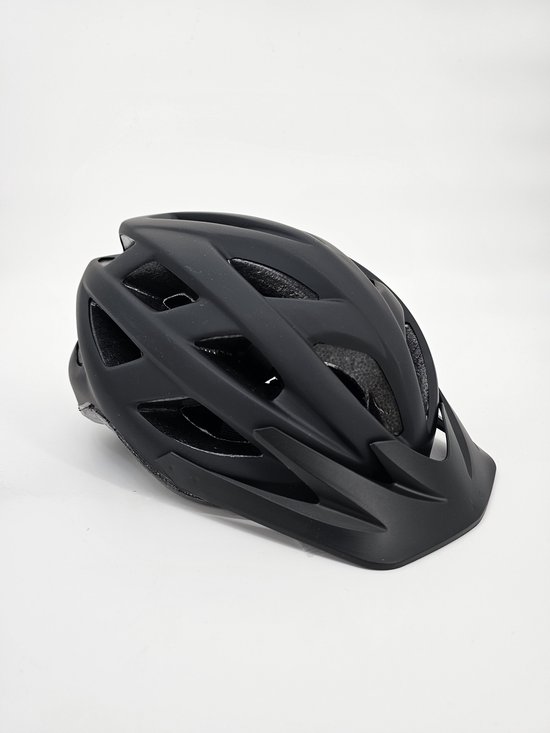
MTB helmets
Fox Racing Speedframe Camo helm
The Fox Racing Speedframe Camo is a mountain bike helmet with a camouflage print, CE marked according to the title. The Speedframe line is made for trail riding.
What you get
- Fox Racing Speedframe Camo model
- CE marking
- Camouflage print
Why an MTB helmet?
You fall differently on a mountain bike than on the road. You often land on trees, rocks or the ground with the back and sides of your head. An MTB helmet covers those areas further. It meets the same European standard, EN 1078, as a road helmet, and full-face downhill helmets often also meet the stricter ASTM F1952.
The visor shades your eyes from sun, rain and branches. It should be able to swivel or break away in a crash, and many models let you raise the visor to wear goggles or glasses.
There are roughly four kinds. XC helmets are light (about 250 to 350 g) and airy. Trail and all-mountain helmets cover more and weigh about 300 to 450 g. Enduro helmets have a removable chin bar. Full-face helmets weigh about 800 to 1200 g and also protect your chin and face, made for downhill and bike parks.
Here too, MIPS or a similar system is an extra option. It can reduce rotational forces in an angled impact. A helmet that fits well counts for more than any added system.
The types of MTB helmet
The more protection, the heavier and warmer a helmet usually gets.
| Type | Weight | Coverage | For |
|---|---|---|---|
| XC | About 250 to 350 g | Medium, lots of venting | Cross-country and marathon |
| Trail and all-mountain | About 300 to 450 g | High, back and temples | All-round trail riding |
| Enduro with chin bar | About 500 to 900 g | High, chin optional | Steep descents and races |
| Full-face | About 800 to 1200 g | Maximum, chin and face | Downhill and bike park |
Weights are for a medium helmet and differ per model.
Choose it if
- You ride MTB trails and want a branded, CE-marked helmet
- You pick a helmet for its print
- You ride trails, forest paths or a bike park and want more rear protection.
- You want a visor against sun, rain and branches.
Choose something else if
- You mostly ride road, where a lighter road helmet is a better match
- You ride mostly on the road. A lighter, airier road helmet will be more pleasant.
- You want the lightest helmet for long climbs. An XC helmet makes more sense than a full-face.
How to fit and adjust an MTB helmet
Measure your head
Measure your head about 2 cm above your eyebrows and compare it with the manufacturer’s size chart. Sizes differ between brands.
Seat the helmet low enough
An MTB helmet sits lower than a road helmet, about two fingers above your eyebrows. It must cover the back and sides of your head well.
Set the dial and straps
Turn the dial until the helmet is snug and set the straps in a V around your ears. Fasten the buckle with one finger of slack under your chin.
Set the visor
Set the visor so it does not block your view when you look down. If you wear glasses or goggles, raise it a little.
Test on the trail
Shake your head and see if the helmet stays put. After a few rides, check the straps have not loosened.
Good to know
- Size is not in the title, so measure your head and check the size chart
- Replace a helmet after a heavy crash, even if it looks intact
- Replace your helmet after any crash or hard knock, even if you see nothing wrong.
- Manufacturers usually advise replacing a helmet after about 3 to 5 years, because foam and straps age.
- Glasses or goggles can affect how the helmet fits. Try them together.
- Clean the helmet with mild soap and water. Avoid solvents and let it air dry.
Also in this category
- Fischer Urban fietshelm met vizier1 shop · Amazon.nl€19.99
- Dunlop fietshelm met led-licht2 shops · Amazon.nl, Amazon.com.befrom €19.99
- One Bikeparts fietshelm mat zwart1 shop · bol€28.95
- Lichte fietshelm voor MTB en race1 shop · Amazon.com.be€19.43
- One Bikeparts fietshelm rood1 shop · bol€28.95
- Favoto Offroad MTB-helm met dubbele In-mold1 shop · Amazon.nl€47.31