MTB saddles
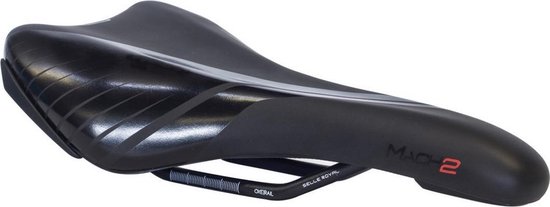
Selle Royal Mach 2 Trekking zadel
The Selle Royal Mach 2 Trekking is a black MTB saddle from Selle Royal. The Trekking name points to longer rides.
What you get
- Bike saddle from Selle Royal
- Mach 2 Trekking model
- For MTB, black
Why an MTB saddle?
On a mountain bike you move all the time. You slide back on a steep descent, forward on a climb and you often stand out of the saddle. An MTB saddle therefore has a flatter top, a nose that does not catch your shorts and rounded edges so you slide across it easily.
The saddle also has to take knocks. In a fall or when the bike tips over, the rear hits the ground. The shell and edges are therefore built stronger than on a road saddle, often with a rubber or reinforced rim. That makes it slightly heavier, usually 200 to 300 g.
You measure width the same way as for a road saddle: the distance between your sit bones, plus usually 10 to 25 mm. On an MTB you sit more upright than on a road bike, which often calls for a slightly wider seat, about 135 to 155 mm. A cut-out or channel reduces pressure here too, especially on long seated climbs.
If you ride with a dropper seatpost, the saddle goes down and up again all the time. Choose a saddle with a rounded rear so you do not snag, and sturdy rails that can take the repeated movement.
How MTB saddles compare
The discipline decides the shape. These are the usual types.
| Type | Use | Shape | Weight |
|---|---|---|---|
| XC and marathon | Long seated climbs | Narrow, light padding | About 150 to 230 g |
| Trail and all-mountain | All-round, up and down | Medium width, flat top | About 200 to 280 g |
| Enduro and downhill | Lots of descending, with dropper | Short, rounded rear | About 230 to 320 g |
| Comfort and e-MTB | Upright position, long days | Wider with more padding | About 280 to 400 g |
Weights are guides and vary by model.
Choose it if
- You ride MTB or trekking and want a Selle Royal saddle
- You want a black saddle that fits your existing seatpost
- You ride unpaved trails regularly, with small and big hits.
- You change position often and want a saddle that stays out of the way.
Choose something else if
- You ride a road bike and want a narrow saddle
- You ride mostly on the road. A road saddle is lighter and suits a leaning position.
- You want the lightest saddle possible. MTB saddles are heavier because they are built stronger.
How to fit an MTB saddle
Check the rails
Check whether your seatpost has a clamp for round 7 mm rails or oval 7 x 9 mm rails. It is stated in the description of both parts.
Place the saddle in the middle
Start with the clamp in the middle of the rails and set the saddle level with a spirit level or ruler.
Tighten the clamp
Tighten the bolt to the value printed on the seatpost or clamp. Preferably use a torque wrench.
Set the height
Sit on the bike with your heel on the pedal at its lowest point. Your leg should be almost straight. With a dropper, set this with the post fully extended.
Test on a short ride
Ride a climb and a descent. Tilt the nose half a degree up or down if you slide forward or feel pressure.
Good to know
- Check the width and length before you choose
- Check that the rails fit your seatpost clamp
- After every crash, check that the rails are straight and the shell is not cracked. A damaged saddle can break suddenly.
- A wider saddle is not always more comfortable. Too wide causes chafing on the inside of your thighs.
- Oval 7 x 9 mm rails do not fit every seatpost clamp. Check before you order.
- Wash the saddle with water and soap. Mud in the seams wears out the cover faster.
Also in this category
- SPGOOD fietszadel met gel2 shops · Amazon.nl, Amazon.com.befrom €18.99
- Rockbros gelzadel met dubbele vering, uitvoering 11 shop · Amazon.com.be€26.99
- Contec Elliptic+ gelzadel1 shop · bol€48.95
- Dunlop MTB-zadel van kunstleer1 shop · bol€12.49
- BigTron MTB-zadel1 shop · Amazon.nl€14.99
- Comfortabel breed fietszadel1 shop · Amazon.com.be€17.99


