Cycling shoes
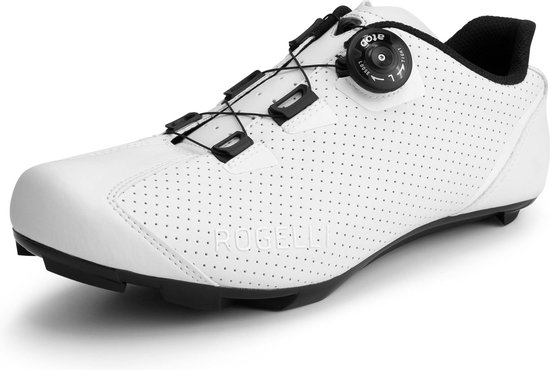
Rogelli R-400 fietsschoenen wit
The Rogelli R-400 is a white cycling shoe for women and men. The title calls it a road cycling shoe for both sexes.
What you get
- Cycling shoes for women and men
- White
- Rogelli R-400 model
Why cycling shoes?
An ordinary trainer flexes with every pedal stroke. A cycling shoe has a stiff sole that stops power from being lost. With a cleat your foot is attached to the pedal, so you can also apply force on the upstroke. The feel is more direct and your foot stays in the same place.
The sole is usually nylon or composite (stiff and affordable) or carbon (stiffer and lighter). Carbon is more efficient at high power, but costs more and is less comfortable on long, easy rides. A stiff sole is an advantage for most riders, and a drawback if you walk a lot.
The closure decides how well the shoe fits. A dial (such as Boa) lets you adjust tension in small steps, even while riding. Laces give the most even fit but are hard to adjust on the road. Hook-and-loop straps are simple and robust but less precise. Many shoes combine two systems.
There are two cleat systems. A 2-bolt cleat (such as Shimano SPD) sits recessed in the sole, so you can walk normally. That suits gravel, MTB and touring. A 3-bolt cleat (such as SPD-SL or Look Kéo) is larger, has a wider platform and suits the road bike, but walking is awkward.
The cleat systems
The cleat system decides which pedals you can use and how you walk.
| System | Mounting | Walking | Suits |
|---|---|---|---|
| 2-bolt SPD | Two bolts, recessed in the sole | Good | Gravel, MTB, touring, commuting |
| 3-bolt SPD-SL | Three bolts, cleat protrudes | Poor, slippery and awkward | Road bike, long rides |
| 3-bolt Look Kéo | Three bolts, same pattern | Poor, like SPD-SL | Road bike, other pedal family |
Many shoes have two bolt patterns so you can choose. Check before you buy which one your shoe supports.
Choose it if
- You want a white cycling shoe made for women and men
- You ride on the road and want a cycling shoe
- You ride regularly and want to transfer power efficiently.
- You want a firm, stable foot position on long rides.
Choose something else if
- You mainly ride MTB and want a shoe for rough terrain
- You only ride briefly now and then or in everyday clothes. A normal shoe with flat pedals is simpler.
- You walk a lot during your ride. Choose a 2-bolt system or a shoe with a walkable sole.
How to choose and set up cycling shoes
Measure your foot
Measure the length of your longer foot in millimetres, standing, and compare it with the size chart. Shoes run differently between brands, so check the width too.
Check the fit
Your heel should not lift and your toes have roughly half a centimetre of room. Feet swell slightly while riding, so too tight soon hurts.
Fit the cleats
Position the cleat so the ball of your big toe sits over the pedal axle. Tighten the bolts with a hex key.
Set the closure
Tighten the closure firmly but without pressure on the instep. A dial lets you adjust on the road as your foot swells.
Practise clipping in
Practise clipping in and out first while stationary, leaning against a wall. Set the release tension lighter if needed.
Good to know
- Check the size and the type of cleat that fits this shoe
- Sizes vary between brands, so use the shop's size chart
- Cleats wear. Replace them when clipping in feels loose or uncertain or when the shape is worn down.
- Check that your cleat fits your pedal. An SPD cleat does not work on an SPD-SL pedal and vice versa.
- Re-check the cleat bolts now and then and grease the thread lightly. They stay tight and can still be undone later.
- Dry shoes after a wet ride at room temperature, not on a radiator. Heat can damage the sole and glue.
Also in this category
- Fietsschoenen voor SPD en SPD-SL1 shop · Amazon.nl€59.99
- RC302W fietsschoenen voor racefiets1 shop · bol€79.99
- Fietsschoenen voor race en MTB1 shop · Amazon.com.be€39.99