Bikepacking
Evoc Seat Pack Boa 12 zadeltas
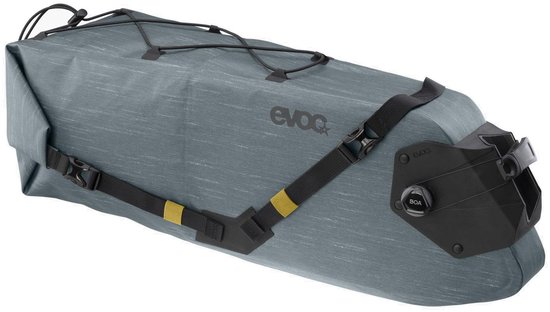
The Evoc Seat Pack Boa 12 is a 12 litre bikepacking saddle pack, 75 cm long, in steel. The Boa system in its name is used to secure it.
What you get
- 12 litre volume
- Length 75 cm
- Steel colour, Boa system
Why bikepacking bags?
A classic rack with two panniers hangs wide and low. On a narrow forest path or singletrack you snag branches and rocks. Bikepacking bags sit close to the frame, in line with the bike, so it stays easy to steer on gravel and trails.
You spread the weight over three spots. Under the saddle goes light, bulky gear such as a sleeping bag and clothes. On the bars sits a roll or harness for the tent or sleeping mat. Inside the frame goes the heavier stuff, like food, water and tools, as low and central as possible. A well-balanced load feels more stable than the same kilos stacked high at the back.
The drawback is volume. Combined you usually get roughly 20 to 50 litres, depending on how many bags you use and how big your frame is. That is enough for a weekend or a light multi-day trip, and tight for a long journey with a lot of cooking kit. You pack more deliberately.
Bikepacking bags are also flexible to fit. Many models need no mounting holes and no rack, so they suit almost any bike, from gravel bike to hardtail and even some road bikes with enough clearance.
The types of bikepacking bag
Every spot on your bike has its own bag. Here is what fits and what to watch for.
| Bag | Position | Volume | Typically holds | Watch for |
|---|---|---|---|---|
| Saddle bag | Under and behind the saddle | About 5 to 15 L | Sleeping bag, clothes | Sways if overloaded |
| Handlebar bag or roll | On the front of the bars | About 5 to 15 L | Tent, mat, light gear | Affects steering |
| Frame bag | Inside the frame triangle | About 3 to 6 L | Food, tools, water | Takes up bottle room |
| Top tube bag | On the top tube | About 0.5 to 1.5 L | Snacks, phone, keys | May rub your knees |
| Fork bag | On the fork | About 3 to 6 L per side | Cook set, water | Needs fork mounts |
Volumes are rough guides. They vary by model and frame size.
Choose it if
- You plan multi-day trips and need 12 litres of space
- You want an Evoc bag for bikepacking
- You plan a weekend or several days on gravel, trails or quiet roads.
- Your bike has no rack or mounts and you do not want to drill or modify the frame.
Choose something else if
- You only carry a spare tube; a smaller saddle bag is enough
- You travel with a lot of luggage or cooking gear. Panniers on a rack give you more space.
- You use your bike daily for commuting with a laptop and clothes. A rack bag suits that better.
How to use bikepacking bags
Pick the right size
Measure your frame space and the gap between saddle and rear tyre before you buy. A bag that is too big rubs on the tyre or your legs.
Distribute the weight
Heavy near the frame, light at the back and front. Put heavy items such as food and tools in the frame bag.
Fasten tightly
Tighten the straps around frame, bars or seatpost until the bag no longer moves. Check that cables and hoses stay free.
Pack and test
Pack everything, keep the weight low and take a test ride of a few kilometres. Adjust the straps and the load if the bike wobbles or the bag rubs.
Protect from rain
Even waterproof bags do not always seal perfectly. Put your sleeping bag and electronics in separate dry bags.
Good to know
- Check clearance between tyre and bag, especially on small frames
- Check seatpost length for a 75 cm bag
- Check that your handlebar bag or roll stays clear of the brake levers and cables, and that your tyre does not touch the saddle bag when the fork is fully compressed.
- A saddle bag has a maximum load, usually around 4 to 6 kg. More than that makes it sway and strains the seatpost.
- A bag on the top tube or inside the frame can wear the paint over time. Stick a bit of protective tape on the contact points.
- Dry your bags fully after a wet ride. Lingering moisture leads to mould and smells.
Also in this category
- YQLAFT frametas 5 liter1 shop · bol€29.99
- Bikepack vorktassen voor gravel1 shop · Amazon.nl€35.49
- Zefal Z Adventure R17 zadeltas1 shop · Amazon.com.be€51.29
- Zadeltas voor bikepacking1 shop · Amazon.nl€7.99
- The Pack AWG bovenbuistas 0,8 liter1 shop · bol€44.95
- Zefal Z Adventure R11 zadeltas 11 liter1 shop · Amazon.com.be€46.95