Multitools
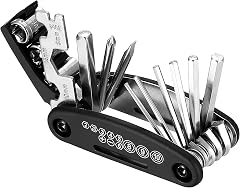
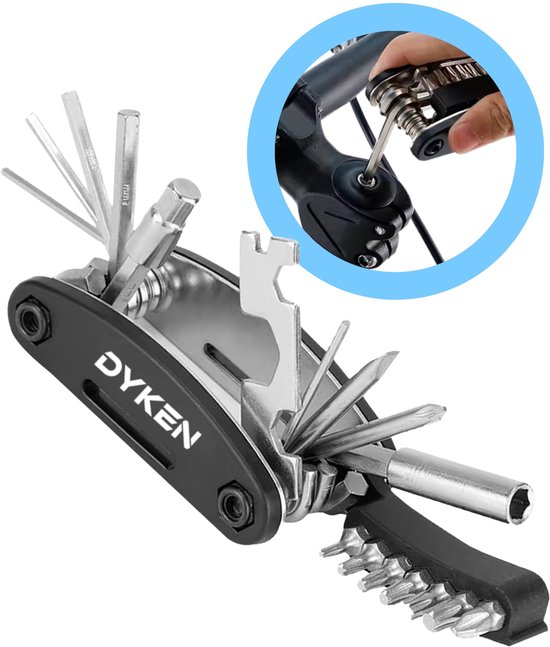
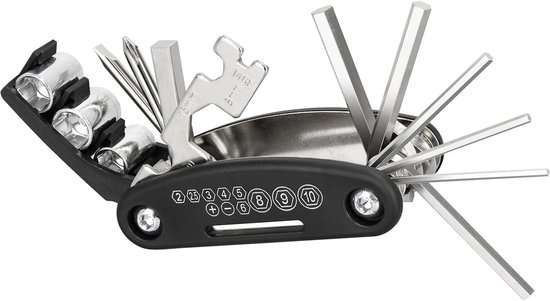
Fietsmultitool 16-in-1
A bike multitool with 16 functions in one compact tool, made for roadside repairs. It replaces several separate wrenches in your saddle bag.
What you get
- 16 functions in one tool
- Made for bike repairs
- Compact size
Why a multitool?
Most bolts on a bike take a hex key. A multitool has them in the common sizes, usually 2, 2.5, 3, 4, 5, 6 and 8 mm, in one folding or sliding body. With it you adjust a saddle, tighten a loose stem or refit a brake, without carrying seven separate keys.
Most multitools also have a Torx key (often T25, the size of the bolts on many brake rotors), a flat and a Phillips screwdriver and sometimes a spoke key. A chain tool is on the fuller models. The number of functions runs from about 8 on a compact one to 20 or more. More functions are not always better: they add weight and make the keys smaller and harder to handle.
Look at weight and feel. A compact multitool typically weighs 60 to 100 g, a full one 150 to 250 g. A long, solid body gives you more leverage on a stuck bolt than a small one. Also check that the keys fold out far enough to reach awkward bolts, such as the seatpost clamp bolt.
If you need a chain tool, choose one that suits the number of speeds on your cassette. A 12-speed chain is narrower than an 8 to 10-speed chain, and not every chain tool handles both.
How multitools compare
The number of functions and the weight go together. Choose what you will really use.
| Type | Functions | Weight | Suits |
|---|---|---|---|
| Compact | About 8 to 12 | About 60 to 100 g | Road bike and short rides |
| Standard | About 12 to 18 | About 100 to 180 g | All disciplines |
| Full with chain tool | About 15 to 25 | About 150 to 250 g | Gravel, MTB, long trips |
| Integrated (bar end or bottle) | About 6 to 10 | About 50 to 120 g | If you want nothing in the bag |
Counts and weights are guides and vary by model.
Choose it if
- You want a compact solution for small adjustments on the road
- You want one tool with many hex keys and screwdrivers
- You want to be able to adjust a saddle, bar or brake on the road.
- You ride outdoors and want one tool for all the common bolts.
Choose something else if
- You need a chain breaker or torque control, so choose a tool that states it clearly
- You work on your bike at home. A set of separate keys and a torque wrench is handier and more precise there.
- You have to tighten bolts to a specified torque. A multitool has no way to measure that.
How to use a multitool
Pick the right key
Try the key in the bolt before you turn. A key with even a little play will round the bolt.
Seat it straight in the bolt
Push the key fully into the bolt and turn in a straight line. Turning at an angle damages bolt and key.
Tighten with feel
Tighten firmly and stay below your full strength. Take extra care with carbon parts. Use a torque wrench at home.
Check your work
Check that the saddle, bar or brake no longer moves. Ride gently for a while and see whether it all holds.
Check the torque at home
At home, recheck bolts you tightened on the road with a torque wrench and the value printed on the part.
Good to know
- The exact sizes and functions are not in the title, so check the list
- Heavy repairs are beyond a small tool, so use full-size tools at home
- Check that the sizes on your bike are included, for example a Torx key for brake rotors.
- A chain tool for 12-speed does not always work on a wider 8 to 10-speed chain. Read the compatibility.
- Rust and dirt stiffen the hinges. Wipe the tool down and put a drop of oil on it now and then.
- A multitool with soft keys rounds off bolts. Choose sturdy steel with a good fit.
Also in this category
- Rockbros 16-in-1 vouwgereedschap1 shop · Amazon.com.be€11.99
- BBB Cycling PrimeFold S multitool1 shop · bol€22.55
- Fietsmultitool 16-in-1 (multifunctioneel gereedschap)2 shops · Amazon.nl, Amazon.com.befrom €8.59
- Fietsmultitool 16-in-1 met inbussleutels1 shop · Amazon.com.be€11.40
- Dyken fietsmultitool 20-delig1 shop · bol€16.95
- Crank Brothers Multi-19 gereedschap2 shops · Amazon.nl, Amazon.com.befrom €24.99