Road saddles
Ultralicht fietszadel van EVA
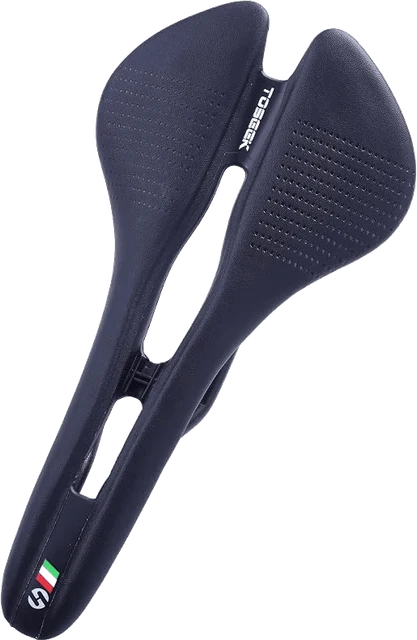
This is an unbranded, ultralight EVA bike saddle sold as a professional saddle. The title says nothing about width, rails or weight.
What you get
- EVA bike saddle
- Described as ultralight
- No brand or size in the title
Why a road saddle?
On a road bike you lean forward and your pelvis tilts ahead. Your weight then rests mostly on your sit bones and less on the soft tissue between them. If the saddle suits that position, you are still comfortable after four hours. If it is too narrow or too wide, you get pressure, chafing and numbness.
The right width depends on the distance between your sit bones. Measure it by sitting on a piece of cardboard or a thick layer of foam and measuring between the centres of the two dents. You usually add 10 to 25 mm, depending on how far forward you lean. Road saddles come in widths of roughly 130 to 155 mm.
A cut-out or channel in the middle reduces pressure on the soft tissue, especially when you ride low. For some riders it makes a big difference, for others a closed saddle works just as well. As for padding, thick foam feels soft in the shop but can cause more friction after hours. A thin, firm pad usually supports your sit bones better on long rides.
The shell is usually nylon or a composite. The rails are steel (sturdy, a little heavier), titanium or carbon (lighter). A road saddle typically weighs 150 to 300 g. A lighter saddle is not automatically more comfortable, so choose on shape and width first.
How road saddles compare
The shape of the saddle decides who it suits. These are the usual types.
| Type | Suits | Padding | Weight |
|---|---|---|---|
| Narrow and flat | A low, fast position | Thin and firm | About 150 to 220 g |
| Medium width, slight curve | Most riders, long rides | Medium | About 180 to 260 g |
| With cut-out or channel | If you feel pressure leaning forward | Medium, often lowered in the centre | About 170 to 270 g |
| Short nose | If you change position often | Medium | About 180 to 250 g |
| Wide with comfort padding | A more upright position, short rides | Thick | About 250 to 350 g |
Weights are guides and vary by model.
Choose it if
- You want to try a lightweight saddle without a big outlay
- You need a simple replacement for a worn saddle
- You ride a road or gravel bike in a sporty, forward-leaning position.
- You regularly ride more than two hours.
Choose something else if
- You want a known brand with clearly listed sizes and rails
- You sit upright on a city or touring bike. A wider comfort saddle suits that better.
- You ride mostly off-road. An MTB saddle is tougher and has reinforced edges.
How to set up a road saddle
Measure your sit bones
Sit on cardboard or foam, measure the gap between the dents and add 10 to 25 mm. That is the width to look for.
Fit it level
Lay a spirit level or a ruler on the saddle and set it flat. Then adjust in small steps.
Set the position on the rails
Slide the saddle forwards or backwards on the rails. Keep the clamp within the markings on the rails.
Tighten to the right torque
Preferably use a torque wrench and the value printed on the seatpost or clamp. Carbon rails often need less.
Ride and fine-tune
Ride for a week before adjusting. Change one thing at a time, for example 2 mm forward or half a degree of tilt.
Good to know
- Look up width, length and rail type on the shop page
- Be careful on long rides, as a light saddle is not always comfortable
- Check whether your seatpost has a clamp for round 7 mm rails or for oval 7 x 9 mm carbon rails. Not every clamp fits both.
- A new saddle takes a few rides to get used to. Do not judge it after one ride.
- A crack in the shell or bent rails after a crash mean the saddle needs replacing.
- Go by the right width, even if the saddle looks too narrow to your eye. Measuring beats looking.
Also in this category
- Boosden fietszadel1 shop · Amazon.nl€22.99
- Travelhawk comfortzadel voor stad1 shop · bol€24.95
- Rockbros gelzadel met dubbele vering, uitvoering 11 shop · Amazon.com.be€26.99
- SPGOOD fietszadel met gel2 shops · Amazon.nl, Amazon.com.befrom €18.99
- Voltano Drifter 2.0 zadel1 shop · bol€32.95
- Selle Italia S5 Superflow zadel1 shop · Amazon.nl€38.95


