Floor pumps
Gobko staande fietspomp met manometer
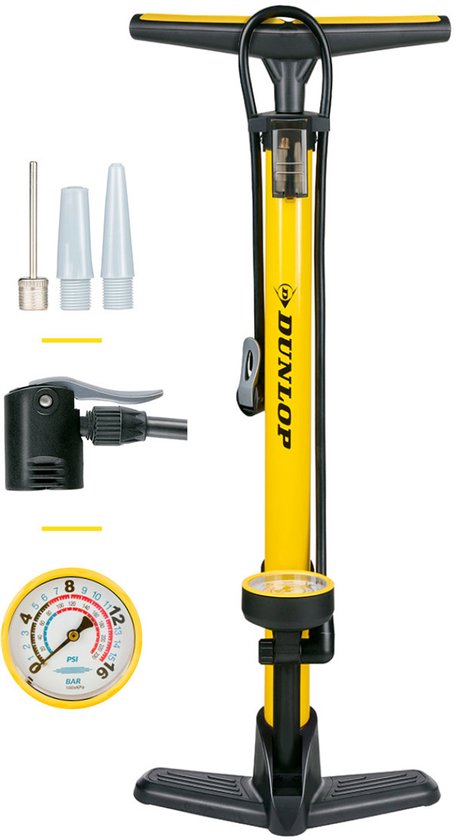
The Gobko floor pump has a gauge so you can read the pressure. The title says it works with Presta, plus other valve types.
What you get
- Floor pump
- With pressure gauge
- Supports Presta
Why a floor pump?
The right tyre pressure is one of the simplest ways to ride better, and it changes because air leaks slowly through the rubber. A road bike loses noticeable pressure in a few days. So top up before every ride. With a floor pump that takes half a minute, where a mini pump costs you minutes.
The pressure range is the first question. Road tyres are usually ridden at about 5 to 8 bar, depending on width, weight and surface. A road floor pump typically goes to about 8 to 11 bar or higher. A tubeless mountain bike needs just 1 to 2 bar. There, volume matters more than pressure: a pump with a large barrel moves more air per stroke.
Then the valve. Presta is the slim valve with a little nut you unscrew, found on most road and gravel bikes. Schrader is the wider car-style valve, common on city bikes and older mountain bikes. Most floor pumps have a head that fits both, sometimes with a reversible piston or two holes. Make sure the pump suits the valves you use.
Electric pumps exist too. They inflate to a set pressure by themselves, which helps if you want a reliable pressure or pumping wears you out. They need mains power or a battery, are often loud and reach road pressures more slowly. A hand pump with a gauge is simpler and lasts for years.
How floor pumps compare
The pressure range and volume decide which bike the pump suits.
| Type | Pressure range | For | Watch for |
|---|---|---|---|
| Road and gravel | Usually up to about 8 to 11 bar | Narrow tyres at high pressure | Slim barrel, many strokes for big tyres |
| High volume (MTB) | About 1 to 4 bar | Wide tyres, tubeless | Does not reach road pressures |
| With tank (tubeless booster) | Up to about 8 to 10 bar in the tank | Seating tubeless tyres | Heavier and bulkier |
| Electric | Usually up to about 6 to 10 bar | If pumping wears you out | Needs power or battery, slower at high pressure |
Pressure ranges vary by model. Read the specifications.
Choose it if
- You want to read your tyre pressure as you pump
- You want a pump for home or the garage
- You pump your tyres at home, before every ride or every week.
- You want to reach the right pressure quickly and accurately, with a gauge you can read.
Choose something else if
- You want a pump for the saddle bag
- You pump up on the road. A mini pump fits your pocket, a floor pump does not.
- You have no space at home and ride little. A mini pump is enough then.
How to use a floor pump
Check the valve
On a Presta, unscrew the nut and press it briefly to free the valve. On a Schrader, this is not needed.
Fit the pump head
Push the head straight onto the valve and close the lever. A crooked head leaks air.
Pump with long, steady strokes
Hold the base down with your feet and use the full stroke. Read the gauge when the pump is at rest.
Stop at the pressure you want
Look at the maximum printed on your tyre or rim. Never go above it.
Remove the head and close the valve
Open the lever, pull the head off quickly and on a Presta screw the nut closed again. Put the cap back on.
Good to know
- Read which other valve types are supported
- Check the maximum pressure for road tyres
- The gauge on a floor pump often reads off by a few tenths of a bar or more. Use it as a guide, not as a precision instrument.
- The maximum pressure printed on your tyre and rim comes first. A tyre pumped above its limit can blow off the rim.
- A Presta valve can bend if the head sits crooked. Always push straight on.
- Now and then lubricate the piston and seal with a drop of silicone or pump oil, and keep the hose clean.
Also in this category
- Dunlop fietspomp 11/12 bar1 shop · Amazon.nl€17.66
- Vogora VuePro fietspomp met manometer1 shop · Amazon.com.be€19.85
- BBB Cycling AirWave vloerpomp1 shop · bol€27.95
- Vogora fietspomp met manometer2 shops · Amazon.nl, Amazon.com.befrom €16.14
- Dunlop fietspomp 11/12 bar1 shop · Amazon.nl€19.19
- Dunlop vloerpomp met drukmeter1 shop · bol€24.99