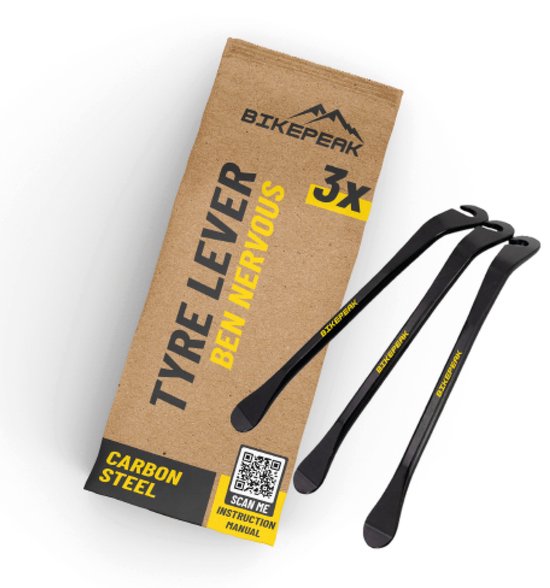
Tyre levers
MSZweirad bandenlichters van metaal
The MSZweirad tyre levers are made of metal, with a sturdy lever per the listing. Metal often holds up better than plastic on a stubborn tyre.
What you get
- Metal tyre levers
- Sturdy lever
Why tyre levers?
A tyre sits on the rim by a firm edge (the bead). After a puncture, that bead has to come off on one side. With your thumbs it sometimes works on a loose tyre, but often not, especially on a new or tight one. Then you want a lever that lifts the tyre without hurting the inner tube or your fingers.
You normally use two or three levers. Slide the first under the bead and hook it on a spoke, put the second a few centimetres further on and run it around the rim. That is enough to free the bead. A third lever speeds things up on a tight tyre.
The material decides how kind the lever is to your rim. Plastic (nylon or glass-fibre reinforced) is light, about 10 to 25 g each, and does not easily damage a rim. Metal levers are stiffer and rarely break. They can scratch an aluminium rim and damage a carbon one. For most riders, plastic is the safest choice.
Look at the shape. A wide, rounded tip grips the bead without pinching the tyre. A hook at the other end lets you fix the lever to a spoke. Tubeless tyres sit tighter, so a sturdy lever is worth more there.
How tyre levers compare
The material decides strength and how your rim reacts.
| Material | Strength | Rim-friendly | Weight (each) |
|---|---|---|---|
| Plastic (nylon) | Good for ordinary tyres | Yes, carbon too | About 10 to 20 g |
| Glass-fibre reinforced | Stronger, breaks less | Yes, aluminium and carbon | About 12 to 25 g |
| Metal (aluminium) | Very strong, for tight tyres | Can scratch, not for carbon | About 25 to 45 g |
| Combined (with key or hook) | Depends on the model | Depends on the material | About 20 to 50 g |
Values are guides and vary by model.
Choose it if
- You use stiff tyres such as gravel or tubeless.
- You want a sturdy set for your toolbox.
- You replace an inner tube or a tyre yourself, at home or on the road.
- You ride tight or tubeless tyres and need more grip than your thumbs give.
Choose something else if
- Metal can damage a carbon rim, so use plastic levers there.
- You ride tubeless and only use plugs. You will need levers less often.
- You want to use metal levers on a carbon rim. That is not recommended.
How to use tyre levers
Let the air out
Let the tyre go completely flat and push the bead on both sides into the centre of the rim.
Insert the first lever
Place the tip under the bead, away from the valve. Push the lever down and hook it on a spoke.
Work around the rim
Place the second lever a few centimetres further on and run it round the rim until the bead is free.
Replace the inner tube
Pull out the old tube, check the inside of the tyre for glass or thorns and fit the new tube with a little air in it.
Refit the tyre
Push the bead onto the rim with your hands. Use the lever only if you really have to, because it is easy to pinch the tube.
Good to know
- The number of levers is not in the title.
- Work carefully to avoid damaging rim and tube.
- Never force a lever under a bead you cannot see. It is the most common cause of a fresh puncture.
- A metal lever on a carbon rim can damage the fibres. Use plastic.
- Always carry at least two levers. One on its own rarely works.
- After the repair, check that the tube is not trapped between bead and rim before you inflate.
Also in this category
- Schwalbe bandenlichters (set van 3)2 shops · Amazon.nl, Amazon.com.befrom €4.90
- BBB Cycling bandenlichter1 shop · bol€11.95
- SKS Germany bandenlichters (set van 3)2 shops · Amazon.nl, Amazon.com.befrom €5.24
- BikePeak Ben Nervous bandenlichters (set van 3)1 shop · bol€9.00
- Prophete bandenlichters (set van 3)1 shop · Amazon.nl€3.91
- Bandenlichters van koolstofstaal (set van 3)2 shops · Amazon.nl, Amazon.com.befrom €6.05