Brake rotors
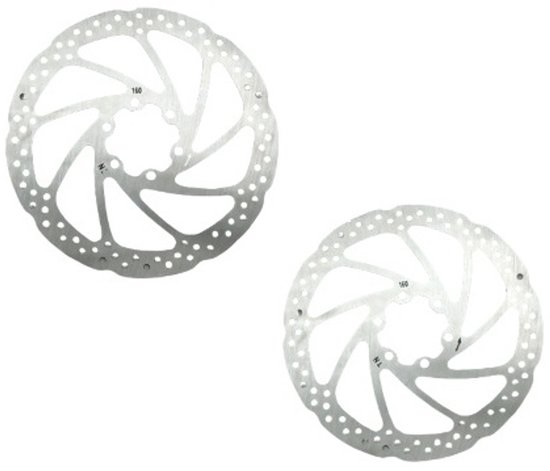
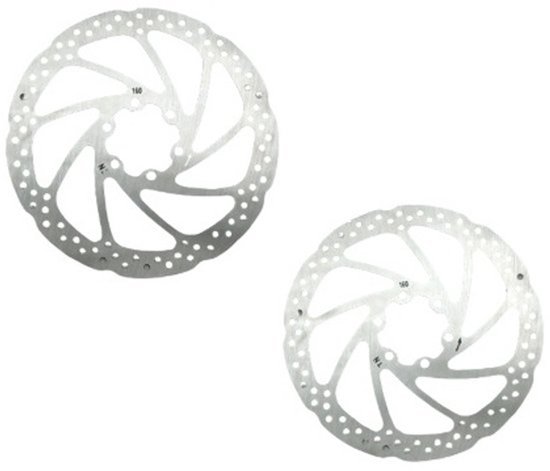
Remschijven MTB 160 mm (set van 2)
A set of two 160 mm MTB brake rotors in stainless steel, supplied with screws. The title also mentions compatibility without spelling it out.
What you get
- 2 rotors
- 160 mm
- Stainless steel, screws included
Why the right rotor?
A rotor wears. A new rotor is usually about 1.8 mm thick and should be replaced around 1.5 mm (see the manufacturer’s figure). A bent rotor rubs on the pads and makes noise. A contaminated rotor brakes poorly, often from oil or grease on it.
Diameter sets the leverage and the heat dissipation. A bigger rotor gives more stopping power and stays cool for longer, but is heavier and will not fit every frame. On the road 140 and 160 mm are common, on gravel 160 and 180 mm, on MTB 180 and 203 mm.
The mount matters too. Center Lock is a splined mount where the rotor is held by one lockring, quick to fit. 6-bolt (IS) uses six small bolts and appears on almost every hub. A Center Lock rotor does not fit a 6-bolt hub without an adapter, and the other way round.
Metal and construction vary. A single-piece stainless steel rotor is tough and simple. A rotor with an aluminium core and steel braking tracks (two- or three-piece) is lighter and sheds heat better, but costs more.
How the sizes compare
A bigger rotor brakes harder and stays cooler, a smaller one is lighter.
| Diameter | Use | Power and heat | Weight |
|---|---|---|---|
| 140 mm | Rear wheel on the road | Enough for lighter riders | The lightest |
| 160 mm | Road, gravel, light MTB | Good baseline, cool enough | About 100 g or less |
| 180 mm | Gravel, XC and trail | Clearly stronger and cooler | A little heavier than 160 mm |
| 203 mm | Heavy MTB and long descents | Maximum power and cooling | The heaviest |
Check the maximum rotor size of your frame and fork. A bigger rotor sometimes needs a different caliper adapter.
Choose it if
- You are replacing worn or bent rotors front and rear
- Your MTB runs 160 mm rotors
- Your rotor is thinner than about 1.5 mm, bent or visibly damaged.
- You brake with a lot of noise and cleaning does not help.
Choose something else if
- You have another rotor size or a Centerlock hub
- You do not know whether your hub is Center Lock or 6-bolt. Check that first.
- Your frame or fork does not allow a bigger rotor. Look up the maximum size in the specifications.
How to fit a brake rotor
Check the mount
See whether your hub is Center Lock or 6-bolt and pick a rotor with the same mount.
Clean the hub
Take off the old rotor and wipe the contact surface clean. Do not touch the braking surface of the new rotor with greasy fingers.
Fit the rotor
With Center Lock, slide the rotor onto the splines and tighten the lockring with the special tool to about 40 Nm. With 6-bolt, tighten the six bolts in a cross pattern.
Check the rotor runs true
Spin the wheel and see if the rotor runs straight in the caliper. A slight bend can be eased out with a rotor truing tool.
Bed in the pads
A new rotor and new pads need bedding in: brake about twenty times from a moderate speed without stopping.
Good to know
- Check whether your hub is 6-bolt or Centerlock
- New rotors need clean brake pads
- Do not touch the braking surface with greasy hands and keep chain spray away. Clean with isopropyl alcohol.
- A rotor gets very hot after long braking. Do not touch it straight after a descent.
- Use the bolts supplied with the rotor and tighten them to the stated torque, as values differ per brand.
- Rotors and pads work as a pair: a resin or metal pad sometimes suits a given rotor better. Check the recommendations.
Also in this category
- Remschijf MTB 160 mm voor e-bike1 shop · Amazon.com.be€9.69
- Remschijven 160 mm 6 gaten, roestvrij staal (set van 2)1 shop · Amazon.nl€10.99
- Roestvrijstalen remschijven 160 mm, 6 bouten (2 stuks)1 shop · bol€11.00
- Remschijven Center Lock (set van 2)2 shops · Amazon.nl, Amazon.com.befrom €9.98
- Remschijven voor Shimano SM-RT56 160 mm (set van 2)1 shop · Amazon.com.be€11.04
- Roestvrijstalen remschijven 160 mm, 6 bouten (2 stuks)1 shop · bol€18.50