Saddle bags
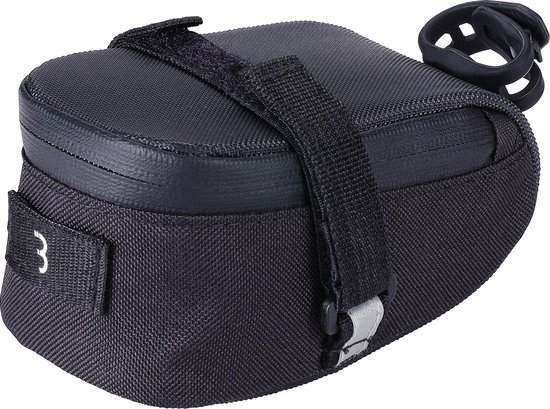
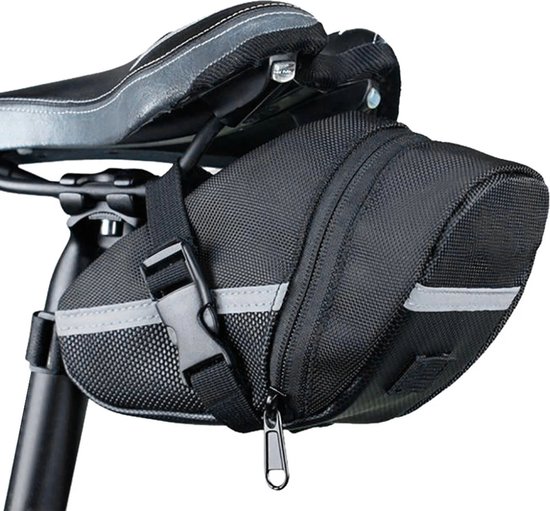
Waterdichte zadeltas van nylon
This is a waterproof nylon saddle bag, meant to sit under the saddle. The title names no brand, so it is a simple bag for a spare tube and tools.
What you get
- Waterproof saddle bag
- Nylon material
- For under the saddle
Why a saddle bag?
A puncture ends your ride unless you have what you need. It is not much: an inner tube, two tyre levers, a mini pump or CO2, a multitool, a patch kit and a quick link for your chain. A saddle bag keeps it together, attached to the bike rather than to you.
Volume is given in litres. A small bag of 0.3 to 0.6 litres holds a tube, levers and a multitool. A standard bag of 0.6 to 1 litre also has room for a pump or CO2 and a little extra. For gravel or long days, 1 to 2.5 litres is common, and for bikepacking there are saddle packs of 5 litres and more. The bigger they are, the heavier they get and the more they can sway.
Fixing methods differ. On most bags, hook-and-loop straps or a buckle go round the rails and the seatpost. Some models have a quick-release that clips onto a mount. A well-fixed bag stays quiet while you ride and does not tilt backwards.
There are downsides too. A bag under the saddle can rub your thighs or shorts if the saddle is low or the seatpost is thin. And it is best to pack only what you need: the fuller the bag, the more it rattles and sways.
How saddle bags compare
The volume in litres decides what you carry and which ride the bag suits.
| Type | Volume | Fits | For |
|---|---|---|---|
| Mini | About 0.3 to 0.6 L | Tube, levers, multitool | Road bike, short rides |
| Standard | About 0.6 to 1 L | Plus pump or CO2 and repair kit | Most rides |
| Large | About 1 to 2.5 L | Extra tube, jacket, food | Gravel and long days |
| Bikepacking | About 5 L and more | Clothing and sleeping gear | Multi-day trips |
Volume varies by model. Read the specifications.
Choose it if
- You want to carry your spare tube and tools dry
- You want a small, simple saddle bag
- You want your repair kit to stay on the bike and your pockets free.
- You often ride alone and need to fix a puncture yourself.
Choose something else if
- You carry a lot of gear; look at a bikepacking seat pack with more volume
- You ride with a dropper seatpost. When the saddle drops, a bag under it touches the rear wheel.
- You have little space under the saddle, for example with a short tail or a low saddle. Choose a mini or a frame bag.
How to use a saddle bag
Pack smartly
Put the heaviest, hardest items at the bottom. Roll the tube and wrap it in a bag to keep it dry and quiet.
Fix it to the rails
Pass the straps or buckles round the saddle rails, under the saddle. Pull them tight so the bag does not move.
Secure the seatpost strap
Pass the second strap round the seatpost. That stops the bag tilting back or bouncing up.
Test the clearance
Check that the bag does not touch your rear wheel, your thighs or a dropper. Shake it to hear whether anything rattles.
Check the contents regularly
Every few months, check that the tube is still good and that the cartridge or patches still work. Replace anything you have used straight away.
Good to know
- Volume and dimensions are not in the title, so check them
- Check that the fixing suits your saddle rails
- Check that the bag fits your saddle rails. Some carbon rails or wide clamps do not allow every type of fixing.
- A full bag starts to sway. Carry only what you really need.
- Protect the contents from rain and damp. A wet tube or rusty tool lets you down.
- Check that your rear light is still visible. A bag can hide a small light under the saddle.
Also in this category
- Zadeltas voor bikepacking1 shop · Amazon.nl€7.99
- Waterdichte zadeltas met reflectie2 shops · Amazon.nl, Amazon.com.befrom €14.62
- BBB Cycling SpeedPack zadeltas (race, stad en MTB)1 shop · bol€26.95
- Flintronic mini-zadeltas reflecterend2 shops · Amazon.nl, Amazon.com.befrom €7.99
- BBB Cycling EasyPack zadeltas 0,37 liter1 shop · bol€18.59
- Lumiere & Co. fietszadeltas voor racefiets (kleine uitvoering)1 shop · Amazon.com.be€23.34