Torque wrenches
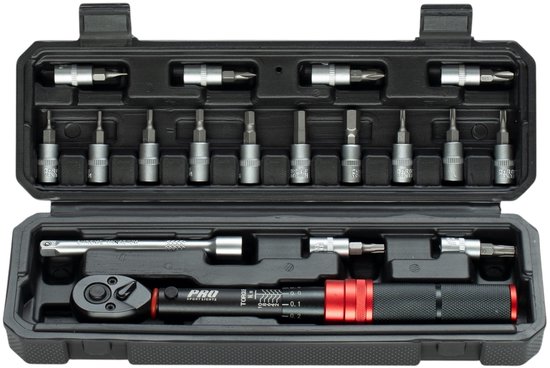
Momentsleutel met 16 bits
This bike torque wrench comes with 16 bits in a compact package. The title mentions Pro Sport Lights, which looks like a name or series.
What you get
- Bike torque wrench
- 16 bits
- Compact size
Why a torque wrench?
Tightening by feel often works, but not always. Too loose and a handlebar or seatpost can slip. Too tight and you snap a bolt, crack a carbon part or strip the thread. The gap between right and wrong can be small, and you usually notice only once it has gone wrong.
Torque is given in newton metres (Nm). Many bike parts have the value printed on them, for example near the bolts of a stem or seatpost. The value on the part always comes first. As a guide: bolts for handlebar, stem and seatpost usually sit between 5 and 8 Nm, rotor bolts around 5 to 6 Nm and a cassette lockring around 40 Nm. Heavier parts such as crank arms or a bottom bracket often need 35 Nm or more.
A useful home torque wrench covers roughly 2 to 24 Nm. That handles handlebar, stem, seatpost, rotors and most small bolts. The type matters too: a click wrench gives a clear click and a felt vibration at the set value, a preset wrench does a single value, and a digital wrench shows the value on a screen.
With carbon, the manufacturer often gives a lower value, sometimes 4 or 5 Nm. With a torque wrench you stay safely under it and use carbon paste to stop slipping without tightening harder.
How torque wrenches compare
The mechanism and range decide what the wrench is good for.
| Type | How it works | Range | Watch for |
|---|---|---|---|
| Preset wrench | Clicks at one value, e.g. 4, 5 or 6 Nm | One value per wrench | Light and simple, one fixed value |
| Adjustable click wrench | You set the value, it clicks there | Usually about 2 to 24 Nm | Return to lowest setting after use |
| Beam or dial wrench | You read the value off a scale | Depends on the model | Reading takes attention |
| Digital wrench | Screen and beep or vibration at the value | Depends on the model | Needs a battery |
Check the range the maker states.
Choose it if
- You tighten carbon parts and want the right torque
- You want many bit sizes in one compact kit
- You have carbon parts, such as bar, stem or seatpost, that must not be overtightened.
- You work on your own bike and want repeatable tightening.
Choose something else if
- You want to see the setting range: the title gives no Nm range
- You ride little and have a workshop service your bike. They already have the tools.
- You want something for the road. A torque wrench is too big for a saddle bag.
How to use a torque wrench
Look up the value
Read the value printed on the part. If there is nothing, look up the maker’s data. The value on the part always comes first.
Set the wrench
Turn the scale to the value you want. Fit the right bit or socket on the wrench.
Clean thread and bolt
Use grease on aluminium and steel, carbon paste on carbon. Thread the bolt in by hand first.
Tighten until the click
Pull smoothly and evenly. Stop as soon as you feel the click. Do not tighten again. On a stem faceplate, tighten the bolts alternately in small steps.
Return the wrench to its lowest setting
After use, wind the spring back to its lowest value. That keeps it accurate.
Good to know
- Check the Nm range in the shop
- Check that all the bits you need are included
- Use a torque wrench only to tighten, never to free a stuck bolt. That damages the mechanism.
- Do not drop the wrench and keep it in its case. A fall can shift the setting.
- A torque wrench does not stay accurate forever. With heavy use, have it checked now and then.
- Check that the wrench range covers the value you need. Below the minimum and above the maximum it is not reliable.
Also in this category
- Momentsleutel 2-24 Nm 1/4 inch2 shops · Amazon.nl, Amazon.com.befrom €21.99
- Momentsleutel 3/8 inch 5-60 Nm2 shops · Amazon.nl, Amazon.com.befrom €23.19
- BBB Cycling momentsleutelset 2-14 Nm1 shop · bol€55.09
- Shall momentsleutelset 15-delig1 shop · Amazon.com.be€28.99
- Hychika momentsleutel 5-25 Nm2 shops · Amazon.nl, Amazon.com.befrom €30.49
- BBB Cycling momentsleutelset 2-24 Nm1 shop · bol€66.33


