Handlebars
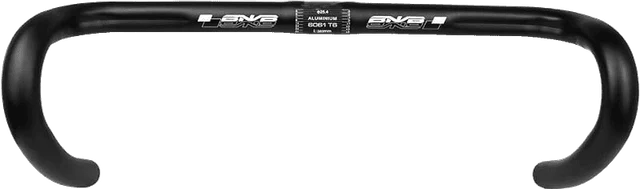
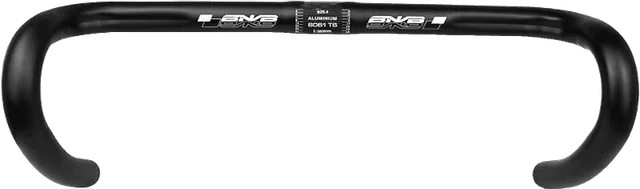
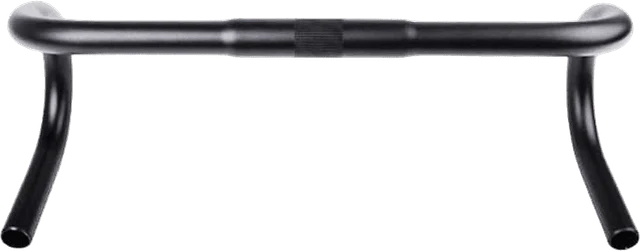
Ergo racestuur 420 mm aluminium
This ERGO handlebar is a lightweight black aluminium drop bar for road bikes, listed at 302 g.
What you get
- Width 420 mm
- Clamp diameter 25.4 mm
- Aluminium, black
- Listed weight 302 g
Why the right handlebar?
A handlebar that does not suit you shows up in your shoulders, neck and wrists. The width should roughly match your shoulder width. On a road bar that is usually 38 to 44 cm (measured centre to centre). A bar that is too narrow makes breathing and steering harder, one that is too wide costs aerodynamics and makes the bike heavier to steer.
With a drop bar you look at two measures: reach and drop. Reach is how far the bar projects forward, usually 70 to 100 mm. Drop is how deep the drops sit, about 100 to 140 mm. A short reach and drop make the position easier, larger values give a sportier posture. A gravel bar often has flare: the drops angle outward, giving more control and a wide grip low down.
MTB bars are wide, usually 720 to 800 mm, with a little rise and a backsweep. A wider bar gives more control downhill, but can be awkward in the woods. You can cut it down yourself.
The clamp has to match your stem. The standard is 31.8 mm, with 35 mm on some bikes or an integrated cockpit. Aluminium is strong and easy to handle, carbon is lighter and damps vibration better, but is sensitive to overtightening and to crash damage.
How the types compare
The bar shape decides your position and how much control you have.
| Type | Width | Reach and drop | Suits |
|---|---|---|---|
| Road drop bar | 38 to 44 cm | Reach 80 to 100 mm, drop 125 to 140 mm | Sporty, fast riding |
| Compact or shallow bar | 38 to 42 cm | Reach 70 to 80 mm, drop 100 to 125 mm | Comfort and smaller hands |
| Flared gravel bar | 40 to 50 cm at the drops | Flare 12 to 30 degrees | Gravel and unpaved roads |
| MTB riser bar | 720 to 800 mm | Rise 0 to 40 mm | Climbing, descending and technical |
Values are guidelines and vary by model. Check the dimensions of the bar you are considering.
Choose it if
- Your stem has a 25.4 mm clamp.
- You want a narrow, light 420 mm road bar.
- You have shoulder, neck or wrist pain and want to fine-tune your position.
- You want more control on gravel or downhill, with a wider or flared shape.
Choose something else if
- If your stem clamps at 31.8 mm, pick a bar with that diameter.
- Your stem has a different clamp diameter (31.8 or 35 mm). The bar will not fit without a new stem.
- Your bike has an integrated bar and stem in one piece. You would have to replace the whole unit.
How to fit a handlebar
Check the clamp diameter
Check that the bar clamp area and stem match, usually 31.8 mm. Measure with calipers if in doubt.
Remove the old bar
Remove the tape, levers and any brake and gear cables. Undo the faceplate bolts and take the bar off.
Position the new bar
Seat the bar in the stem and snug up the faceplate bolts gently. Set the bar to the angle you want. On carbon, use assembly paste.
Tighten in a cross pattern
Tighten the bolts in a cross pattern, a little at a time, to the stated torque (usually 5 to 6 Nm). Keep the gap even top and bottom.
Fit levers and tape
Put the levers back at the right height, route the cables and wrap fresh tape. Test brakes and shifting before you set off.
Good to know
- Check your stem's clamp diameter before ordering.
- Plan for new bar tape and possibly cables.
- Never overtighten the bolts on a carbon bar and use a torque wrench. Replace a scratched or damaged carbon bar.
- After a crash a bar can have invisible cracks. Replace it if in doubt, as it is a safety part.
- A wider bar means adjusting levers and cable lengths. Check after fitting that everything works.
- Check the bolts regularly. A loose bar is dangerous.
Also in this category
- Platt racestuur 25,4 mm 380 mm1 shop · Amazon.com.be€25.99
- Platt racestuur 25,4 mm aluminium gebogen2 shops · Amazon.nl, Amazon.com.befrom €25.99
- Platt racestuur 25,4/31,8 mm aluminium1 shop · Amazon.com.be€25.99
- Bediffer aluminium racestuur1 shop · Amazon.com.be€31.09
- Upanbike racestuur 25,4 mm1 shop · Amazon.nl€16.24
- Platt MTB-stuur 31,8 mm 720 mm1 shop · Amazon.com.be€29.52