Chains
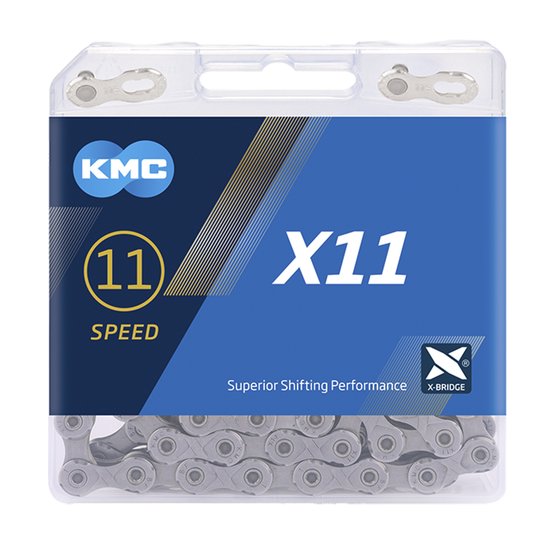
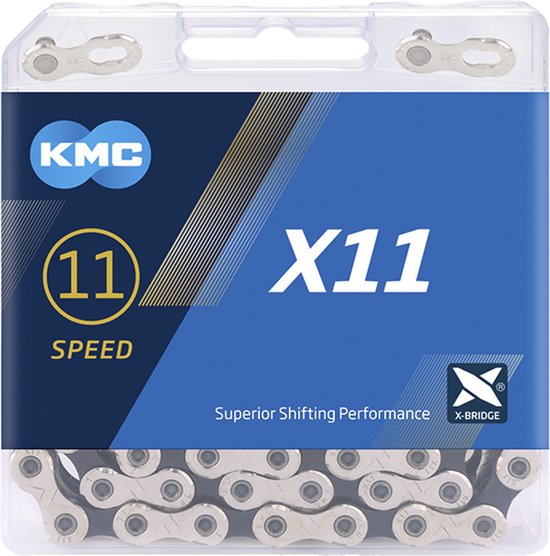
Fietsketting 11 versnellingen 116 schakels 1/2 x 11/128
A bike chain for 11 speeds, 116 links, in 1/2 x 11/128 inch. The title carries no brand name.
What you get
- 11 speeds
- 116 links
- 1/2 x 11/128 inch
Why a new chain?
The pins and rollers of a chain wear, so the chain seems to stretch and the pitch grows beyond the standard 12.7 mm (half an inch). A worn chain sits badly on the teeth and wears the cassette and chainrings with it. Replacing it in time costs less and is simpler than replacing everything at once.
You measure wear with a chain checker. As a rule of thumb, replace an 11 or 12-speed chain at about 0.5 % stretch and a 9 or 10-speed one at about 0.75 %. Past 1 %, the cassette probably needs replacing too. A chain typically lasts around 2,000 to 5,000 km, depending on lubrication, weather, rider weight and how you shift.
The number of gears decides the width. The more sprockets on the cassette, the narrower the chain must be: about 6.6 mm for 9-speed, 5.9 mm for 10, 5.5 mm for 11 and roughly 5.2 mm for 12. A chain made for a different number of gears shifts badly or touches the next sprocket. Always pick the number that matches your cassette and shifter.
You close chains with a quick-link or a special connecting pin. A quick-link opens and closes without tools, which makes washing and replacing easy. Some brands make quick-links for single use, others reusable ones. Read the instructions that come with the product.
Chains for 9 to 12 gears compared
The more gears, the narrower the chain. That affects wear and how the chain closes.
| Gears | Width (approx.) | Replace at stretch | Quick-link | Watch for |
|---|---|---|---|---|
| 9-speed | About 6.6 mm | About 0.75 % | Usually reusable | Sturdiest, forgiving with dirt |
| 10-speed | About 5.9 mm | About 0.75 % | Usually reusable | Common on older and mid-range bikes |
| 11-speed | About 5.5 mm | About 0.5 % | Single-use or reusable, per brand | Measure carefully, keep it clean |
| 12-speed | About 5.2 mm | About 0.5 % | Often single-use or a special pin | Narrowest, wears faster, system-specific |
A general guide. Dimensions and wear limits differ by brand, so follow the manufacturer’s figures.
Choose it if
- You need an 11-speed chain with 116 links
- You fit the chain yourself
- Your chain looks worn or jumps over the cassette when you push hard.
- Your chain checker reads about 0.5 % (11 or 12 gears) or 0.75 % (9 or 10 gears).
Choose something else if
- Your cassette has a different number of speeds
- You want a tested branded chain
- You do not know how many gears your bike has. Count the sprockets on your cassette first.
- Your chain is new and shifts well. Wait until the chain checker says otherwise.
How to fit a chain
Check the number of gears
Count the sprockets at the back and check that the brand and range suit your drivetrain. Choose a chain for the same number of gears.
Remove the old chain
Open the quick-link with quick-link pliers, or push out a pin with a chain tool. Note how the chain ran, or count the links.
Set the length
Lay the new chain beside the old one or follow the manufacturer. For a new chain, check it works on the biggest chainring and biggest sprocket without tensioning. Remove extra links with the chain tool.
Route and join the chain
Thread the chain through the rear derailleur and join it with a quick-link or the supplied pin. Respect the running direction if the chain shows one.
Check and lube
Flex a stiff link and turn the pedals. Check every gear, lube the chain and wipe off the excess.
Good to know
- Trim the chain to suit your drivetrain if needed
- Check whether a quick link is included
- The number of gears must match the cassette and shifter. An 11-speed chain on a 12-speed cassette will not work.
- Join the chain with the part the manufacturer prescribes. A quick-link for a different number of gears can break or skip.
- Measure the chain regularly. Wait too long and the cassette wears too, which makes the job much more costly.
- Some chains have an outer side or a running direction. Fit it as marked.
Also in this category
- Shimano HG601 ketting 11-voudig1 shop · Amazon.com.be€23.28
- KMC X11 ketting 11-voudig 118 schakels1 shop · bol€25.25
- Fietsketting 10-voudig1 shop · Amazon.com.be€8.99
- Fietsketting 116 schakels 6 tot 12-voudig1 shop · Amazon.nl€17.18
- KMC X11 ketting 11-voudig 114 schakels1 shop · bol€35.99
- KMC MissingLink 11-voudig (set van 2)1 shop · bol€11.00