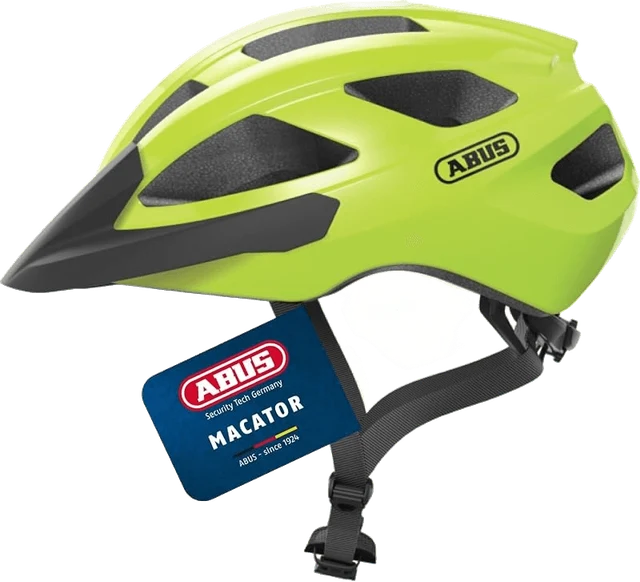
Road helmets
Fischer Urban fietshelm met vizier
The Fischer Urban is an adult bike helmet with a visor and adjustable fit. It is designed for everyday city riding, although it is listed under road helmets.
What you get
- Fischer Urban bike helmet
- With visor
- Adjustable, for adults
Why a road helmet?
In a road crash your head is the most vulnerable part. A helmet absorbs some of the impact because the EPS (expanded polystyrene) foam under the shell compresses. Less force reaches your brain. The helmet must meet the European standard EN 1078, which tests shock absorption, strap strength and stability on the head, among other things. Look for the CE mark and the EN 1078 reference.
A road helmet is lighter and airier than a city helmet. Roughly 200 to 300 g is typical, with plenty of vents guiding air over your head. That keeps you cool at speed and on climbs. Aero models close up more and run warmer, but cut through the wind more efficiently.
Many helmets include MIPS or a similar system. An inner layer can move slightly relative to the shell to reduce rotational forces in an angled impact. That can help in some crashes, although the effect depends on the fall and the test. The system makes the helmet a bit warmer and heavier.
The best helmet is the one that fits well. A helmet that is too loose or sits crooked protects far less. Try several models if you can, because shapes differ. What suits one head shape may press on another.
The types of road helmet
Road helmets differ mainly in ventilation, weight and added protection.
| Version | Weight | Ventilation | Note |
|---|---|---|---|
| Standard | About 220 to 300 g | Good, many vents | Meets EN 1078 |
| With MIPS | About 250 to 330 g | Good, slightly warmer | Inner layer for rotational forces |
| Aero | About 280 to 350 g | Lower, warmer on climbs | Wind gain at high speed |
| Lightweight climbing helmet | About 180 to 230 g | Very good | Shell may be less robust |
Weights are for a medium helmet and differ per model.
Choose it if
- You mostly ride in town and want a visor against sun or rain
- You want an adjustable Fischer helmet
- You ride on the road and want a light, well-ventilated helmet you can wear for hours.
- You are looking for a helmet that meets EN 1078 and sits comfortably.
Choose something else if
- You ride sportily on the road and want a light, well ventilated road helmet
- You ride mostly off-road. An MTB helmet with more rear coverage fits better.
- You only make short city trips. A city helmet with more coverage may be more comfortable.
How to fit and adjust a road helmet
Measure your head
Wrap a tape measure about 2 cm above your eyebrows around the widest part of your head. The circumference sets the size, for example roughly 55 to 59 cm for M.
Place the helmet level
Set the helmet level on your head, about two fingers above your eyebrows. It must not tilt backwards or forwards.
Set the rear dial
Turn the dial at the back so the helmet sits firmly without pressure. Shake your head: it should barely move.
Adjust the straps
The straps form a V around your ears. Fasten the buckle so one finger fits between your chin and the strap.
Test the fit
Open your mouth wide: the helmet should pull down. Push it with your hand; it must not slide over your forehead or back of your head.
Good to know
- The size or head circumference range is not in the title, so measure your head and compare
- This is the first of three listings with the same title, so read the product page for differences
- Replace your helmet after any crash or hard knock, even if you see nothing wrong. The foam may be compressed with no visible damage.
- Manufacturers usually advise replacing a helmet after about 3 to 5 years, because foam and straps age with sweat, sun and use.
- Clean the helmet with mild soap and water, no solvents. Chemicals can attack the foam.
- Store the helmet at room temperature, out of the sun. Do not leave it in a hot car.
Also in this category
- Lichte fietshelm voor MTB en race1 shop · Amazon.com.be€19.43
- Dunlop fietshelm met led-licht2 shops · Amazon.nl, Amazon.com.befrom €19.99
- Cube Quest fietshelm1 shop · bol€89.95
- Fischer Urban fietshelm met vizier1 shop · Amazon.nl€19.99
- Abus Macator racefietshelm sportief (Amazon.com.be)1 shop · Amazon.com.be€42.09
- Fietshelm voor volwassenen met led-verlichting (3 standen)1 shop · Amazon.nl€20.99