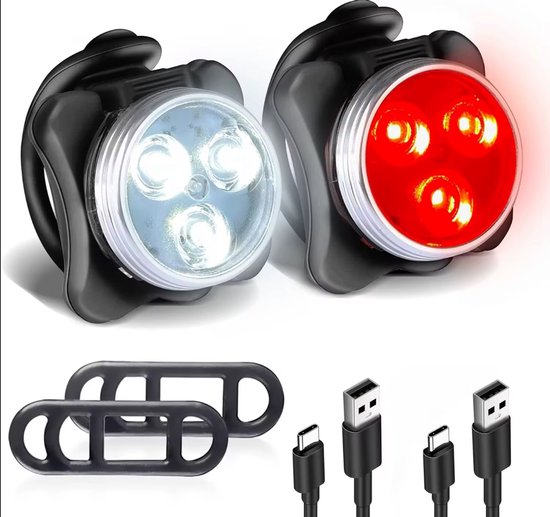
Rear lights
Led-fietsverlichting voor en achter, USB oplaadbaar
This light set has an LED front light and a rear light that charge over USB. The title is cut off, so some specifications are missing.
What you get
- LED front light and rear light
- USB rechargeable
- Front and rear set
Why a good rear light?
A car coming up behind you sees you late. A rear light gives the driver more time to react, and it gets noticed better when it is bright, visible from the side and uses the right pattern. That is why many cyclists ride with a light on in daylight too.
Brightness is given in lumens. For city traffic and dark roads, 15 to 50 lumens is usually enough. To stand out in daylight, choose 50 to 100 lumens or more, in a flashing or pulsing mode. More lumens means shorter battery life, so there is always a trade-off between brightness and runtime.
The mode matters a lot. A steady light is always easy to see and shows the distance to your bike better. A flashing light draws attention faster, but makes it harder to judge distance. A pulsing mode sits in between. Also look at side visibility: a light that also shines left and right makes you visible at junctions.
Check the rules in your country. In many countries the light must be red and may flash or burn steadily. Some countries require an approved light, for instance with a road-use mark.
How the modes compare
A rear light usually offers several modes. They differ in visibility and runtime.
| Mode | Visibility | Judging distance | Battery | Best for |
|---|---|---|---|---|
| Steady | Good | Easiest | Shorter at high output | Dark roads and groups |
| Flashing | Very high | Harder | Longer than steady | Daylight and city traffic |
| Pulsing | High | Fairly good | Between steady and flashing | All-round, day and dusk |
| Eco mode | Moderate | Good | Longest, often tens of hours | Long rides and tours |
Runtime and brightness vary by model.
Choose it if
- You want front and rear in one go and no batteries to buy
- You prefer charging over USB
- You ride on roads with cars, in daylight too, and want to be noticed early.
- You ride at dusk, in rain or through winter.
Choose something else if
- You often ride at night on unlit roads: look at a stronger front light
- You only ride on closed or car-free routes and want a simple light: a basic model will do.
- You want to know what is coming up behind you: a radar light adds that.
How to use a rear light
Charge it
Charge the light fully before you go. The indicator lamp often shows the charge level.
Mount it on the seatpost
Clip the light to the seatpost or saddle bag. It should point straight back and not be hidden by your jacket or bag.
Pick a mode
Choose steady in the dark and on busy roads, pulsing or flashing by day. Use an eco mode for long rides.
Check before you ride
Step behind your bike and check that the light works and sits straight.
Good to know
- Check brightness and run time in the shop, as the title lists neither
- Make sure the lights suit road use
- Check the runtime in the mode you actually use. The stated time often applies to the most economical mode.
- Keep the USB port or charging cable cover closed against water. Moisture in the port shortens the life of the light.
- A clamp that works loose over time lets the light tilt down. Tighten it.
- Keep the light on your bike for daytime rides too. Visibility works best when it becomes a habit.
Also in this category
- EBUYFIRE achterlicht USB 120 lumen1 shop · Amazon.com.be€6.28
- Büchel Tivoli led-achterlicht voor bagagedrager2 shops · Amazon.nl, Amazon.com.befrom €9.08
- Travelhawk fietslichtset1 shop · bol€24.95
- Dula fietslichtset voor en achter1 shop · bol€9.99
- AXA Slim Steady achterlicht (StVZO)1 shop · Amazon.nl€12.20
- Ravemen CL01 achterlicht met groothoek1 shop · Amazon.com.be€21.99


