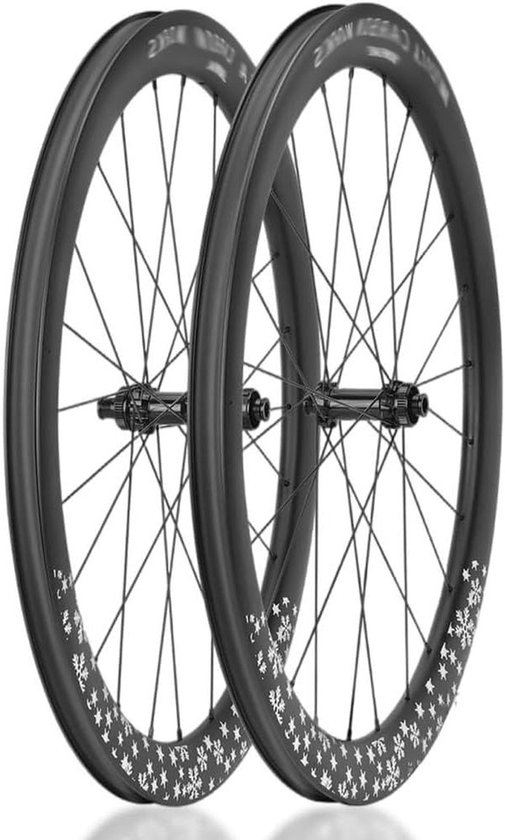
Road wheels
Racewielset
A road wheelset whose listing mainly points to the bearings. Little else is stated, so it pays to read the shop specifications closely.
What you get
- Road bike wheelset
- Bearings mentioned in the listing
Why upgrade your wheels?
Wheels are one of the most noticeable upgrades. Rotating weight costs more energy than weight on the frame, so lighter wheels feel livelier when accelerating and climbing. Stiffer wheels lose less energy in corners and sprints.
The rim profile is the main choice. A shallow rim (under 35 mm) is light, comfortable and stable in crosswinds. A deep rim (50 mm or more) is more aerodynamic above roughly 30 km/h, but heavier and more affected by crosswinds. A mid-depth profile (35 to 50 mm) tries to get the best of both.
Carbon or aluminium is the second choice. Carbon allows a deeper, lighter profile and is stiff, but costs more and handles braking heat poorly on rim brakes. Aluminium is tough and easy to look after. With disc brakes the heat problem disappears.
Look at the internal rim width. Modern rims are 19 to 25 mm wide inside and suit 25 to 32 mm tyres. A wider rim shapes the tyre better and adds comfort.
Deep or shallow rim profiles
Rim depth decides the main characteristics of your wheel.
| Profile | Weight (set) | Wind and speed | Comfort | Crosswind and braking |
|---|---|---|---|---|
| Shallow (under 35 mm) | Usually 1,400 to 1,600 g | Less aero, strong climbing | Compliant, soft | Stable. Rim braking works well |
| Mid (35 to 50 mm) | Usually 1,450 to 1,700 g | Good balance | Average | Usually calm in crosswinds |
| Deep (50 mm or more) | Usually 1,600 to 1,900 g | Aero gain above 30 km/h | Stiffer, harsher | Crosswind-sensitive. Mainly disc brakes |
Weights are indicative and depend on material, hub and brake type.
Choose it if
- You want a spare or replacement set and will check the specifications yourself
- You want a plain set with no brand story
- You want to ride faster or lighter on tarmac.
- You ride often in a group or on flat terrain and can use the aero benefit.
Choose something else if
- You want a known brand or documented weights, in which case pick a set from a brand with full specifications
- You ride mostly in mountains and a lot of wind: choose a shallower profile.
- You want the best value for performance: your existing wheels may be enough.
How to choose and fit road wheels
Check the standard
Check whether your frame uses disc or rim brakes, which axle (12 mm or quick release) and which cassette body (Shimano or SRAM XDR).
Pick the profile
Use the table: shallow for mountains and comfort, deep for speed on flat ground, mid as a compromise.
Fit the cassette and tyre
Slide your cassette onto the hub and tighten the lockring to the right torque. Then fit your tyre and tube or sealant.
Seat the wheel in the frame
Push the axle fully into the dropouts, tighten the thru-axle or quick release and check the wheel sits straight between the brakes.
Check the brake and wheel true
Spin the wheel: it should not rub on the pads or rotor. If it wobbles slightly, have the spokes trued at a workshop.
Good to know
- Brake type, rim size and material are not in the title
- Check the freehub body and axle sizes before ordering
- Check whether carbon braking surfaces need special brake pads.
- Have spokes and bearings checked yearly. Loose spokes cause wobble.
- Respect the maker’s maximum system weight (rider, bike and luggage).
- Deep rims are sensitive to crosswinds, especially for lighter riders.
Also in this category
- Racefietswielset 700C aluminium 40/50 mm, velgrem1 shop · Amazon.nl€185.88
- Racefietswielset 700C 40 mm2 shops · Amazon.nl, Amazon.com.befrom €199.99
- Lichte racewielset1 shop · bol€405.95
- Racefietswielset 700C aluminium 40/50 mm, velgrem1 shop · Amazon.nl€185.88
- Carbon racewielset 50 mm 700C1 shop · bol€755.95
- Racewielset 700C aluminium 30/40/50 mm1 shop · Amazon.nl€202.04