Disc brakes
Schijfremset 160 mm met aluminium remklauwen (Amazon.com.be)
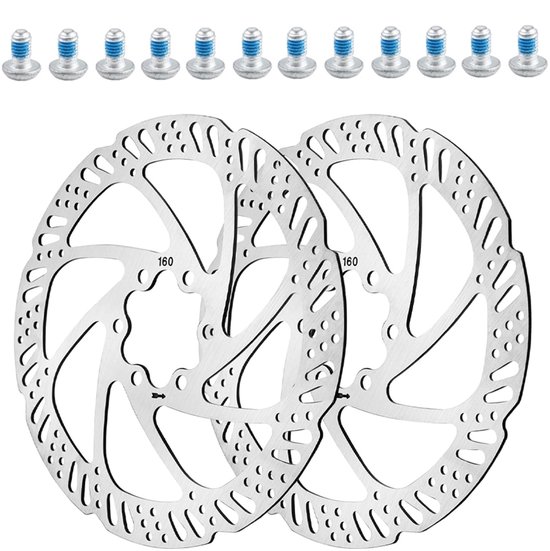
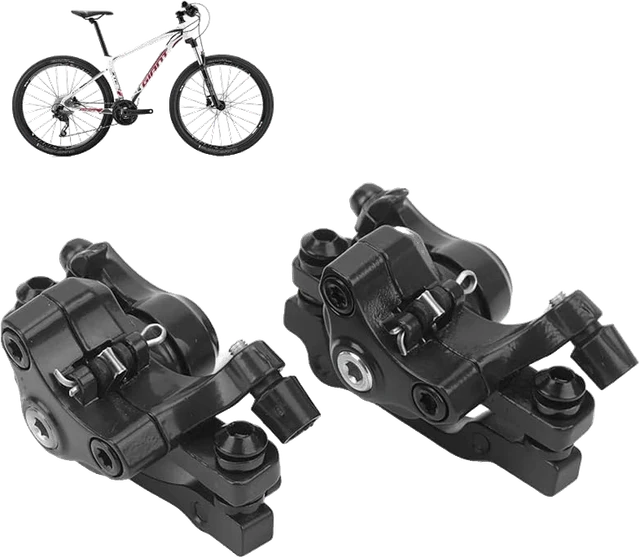
A front and rear disc brake set with aluminium calipers and 160 mm rotors. The title is cut off and names no brand.
What you get
- Front and rear set
- Aluminium caliper
- 160 mm rotor
Why disc brakes?
A disc brake works on a separate rotor, so the rim stays clean and true. In the rain braking power drops far less than with rim brakes. You can also modulate finely, which makes the difference on a long, steep descent or on gravel.
With hydraulic brakes, fluid in a hose pushes the pads against the rotor. That feels light, needs little hand force and adjusts itself as the pads wear. Mechanical disc brakes use a cable. They are simpler to adjust on the road and cost less, but brake less hard and need adjusting more often.
Hydraulic brakes use mineral oil (for example Shimano) or DOT fluid (for example SRAM and Hope). Never mix them: the wrong fluid damages the seals. A caliper has two or four pistons. Four pistons give more power and control, which helps most on heavy MTB riding and long descents.
Brake pads come in resin (organic) and metal (sintered). Resin is quiet, bites straight away and is kind to the rotor, but wears faster and loses power when hot. Metal lasts longer in wet weather and on long descents, but makes a little more noise.
How the systems compare
Hydraulic and mechanical differ in braking power and upkeep.
| System | Power and feel | Upkeep | Watch for |
|---|---|---|---|
| Hydraulic (mineral oil) | Strong and easy to modulate | Bleeding, usually once a year | Never add DOT fluid |
| Hydraulic (DOT) | Strong, higher boiling point | Bleeding, fluid replaced | Absorbs moisture, DOT harms paint |
| Mechanical (cable) | Decent, needs more hand force | Adjust cable, replace pads | Needs adjusting more as it stretches |
| Hydraulic, four pistons | Very strong, good with heat | Bleeding, larger pads | A little heavier, mainly for MTB |
Also check whether your frame uses post mount or flat mount, as the caliper has to match.
Choose it if
- You want to replace or convert to a complete brake set.
- You are after an unbranded set with 160 mm rotors.
- You ride often in rain, mud or mountains and want braking power that stays steady.
- You already have disc brakes and want better or stronger ones.
Choose something else if
- If you want a known brand with easy spare parts, pick a branded set.
- Your frame or fork has no disc brake mounts. You cannot simply fit them.
- You do not want to bleed brakes yourself and have no tools: have a shop do it.
How to use a disc brake
Fit the caliper
Bolt the caliper loosely to the frame or fork mount, using the right adapter for your rotor size.
Centre the caliper
Squeeze the lever and tighten the bolts while holding it. The caliper then sits exactly over the rotor. Tighten to the stated torque, often around 6 Nm.
Bed in the pads
In a safe place, brake about twenty times from a moderate speed to almost a stop, without stopping completely. A layer then forms on pad and rotor.
Check and maintain
Check the pads still have more than about 1 mm of friction material and the rotor is not rubbing. Bleed hydraulic brakes about once a year.
Good to know
- Check that your frame and fork take discs and which mount standard.
- Hydraulic or mechanical is not stated in the title.
- Keep oil, grease and aerosols (chain spray included) away from rotor and pads. Contaminated pads must be replaced and squeal.
- Replace pads when less than about 1 mm of friction material is left. Riding on the metal backing plate damages the rotor.
- Never mix mineral oil and DOT. Check the manual for which fluid your brakes use.
- Do not squeeze the lever with the wheel removed. Put a pad spacer in for transport, or the pistons may push out too far.
Also in this category
- Remschijven 160 mm RVS (set van 2)1 shop · bol€16.95
- Hydraulische schijfremset2 shops · Amazon.nl, Amazon.com.befrom €25.99
- V-brake set voor en achter1 shop · Amazon.nl€12.99
- V-brake set1 shop · Amazon.com.be€11.99
- Hydraulische schijfremset1 shop · Amazon.nl€39.99
- Agatige schijfremset voor MTB1 shop · Amazon.com.be€16.19