Brake pads
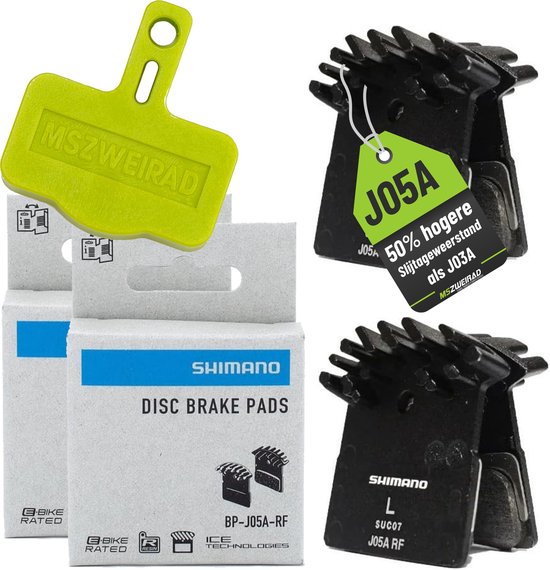
Shimano J05A-RF remblokken met koelribben (2 stuks)
The Shimano J05A-RF are disc brake pads with cooling fins. You get two pads, plus a bleed block according to the shop title.
What you get
- 2 pads J05A-RF
- With cooling fins
- Bleed block included
Why different brake pads?
Brake pads are a wear part. They consist of a metal backing plate with a layer of friction material. When that layer is down to about 1 mm, it is time to replace them. Go further and the metal plate touches the disc and damages it.
For disc brakes you choose between resin (organic), metal (sintered) and semi-metallic. Resin is quiet and bites softly, but wears faster and copes less well with heat. Metal lasts much longer, brakes well in the wet and on long descents, but squeals more easily and wears the disc more. Semi-metallic sits in between.
The right type depends on where you ride. On the road in dry weather, resin works well. For gravel, mountain biking, rain and long mountain descents, metal or semi-metallic is the better pick. On an e-bike or with a heavier rider the heat builds higher, and metal often suits better.
Each caliper has its own pad shape, so choose the model made for your caliper. New pads need bedding in: about 20 to 30 stops from a moderate speed, without coming to a full halt, so the pad material transfers onto the disc.
Types of brake pad compared
Resin, semi-metallic and metal differ in noise, wear and behaviour in the wet and in the heat. The values are guidelines.
| Type | Noise | Wear | Wet weather | Heat |
|---|---|---|---|---|
| Resin (organic) | Quiet | Wears faster, kind to the disc | Good, but wears faster in mud | Can fade on long descents |
| Semi-metallic | Moderate, sometimes a light squeal | Medium | Good | Good |
| Metal (sintered) | Squeals more easily, especially wet | Wears slowly, disc wears more | Very good | Very good, passes on more heat |
| Finned pads | As the pad material | As the pad material | As the pad material | Shed heat better, not in every caliper |
A general guide. Brands and compounds differ, so follow the manufacturer’s data.
Choose it if
- You ride long descents and want pads with cooling fins
- You want pads and a bleed block in one pack
- Your pads are worn down to about 1 mm of friction material.
- Your brake squeals, feels weak or responds poorly after a wet ride.
Choose something else if
- Your brakes are a different type: check that J05A-RF fits first
- Your pads are contaminated with oil or lube. Cleaning rarely helps, so replace them.
- You do not know which model fits your caliper. Check the marking on the caliper or the manual first.
How to fit brake pads
Check the wear
Look at the friction material through the caliper. At about 1 mm or less, replace the pads. Always do both pads in the same caliper.
Remove the wheel and old pads
Take the wheel off. Remove the retaining pin or clip and slide the pads and spring out of the caliper.
Push the pistons back
Push the pistons back gently with a plastic tyre lever or a dedicated tool. Keep clear of the disc.
Fit the new pads
Put the spring and new pads into the caliper without touching the friction material with your fingers, and secure them with the pin or clip.
Refit the wheel and bed in
Refit the wheel, squeeze the lever a few times until it feels firm and check the disc spins freely. Then bed in with about 20 to 30 stops from a moderate speed.
Good to know
- The pad type has to match your caliper, so look up the model
- Replace pads as a pair and think about matching rotors
- Oil, lube or cleaner on pads or disc cuts braking power and causes squealing. Contaminated pads usually need replacing, and the disc is cleaned with brake cleaner.
- Always replace the pads in one caliper together. Uneven pads wear at an angle.
- Check the disc too. A minimum thickness is marked on it, often around 1.5 mm. If it is thinner or warped, replace it.
- A soft lever after fitting points to air in the line or a piston that did not retract properly. Have the brake checked or bled.
Also in this category
- Shimano B05S-RX remblokken met veer1 shop · Amazon.nl€9.09
- AGPTEK schijfremblokken hars (4 stuks)1 shop · Amazon.com.be€9.85
- Cyclotech remblokken voor Shimano XT1 shop · bol€19.95
- Metalen schijfremblokken (4 paar)1 shop · Amazon.com.be€7.29
- Schijfremblokken voor Shimano B01S/B03S/B05S en Tektro1 shop · Amazon.nl€16.79
- Shimano B05S remblokken (hars, bulk)1 shop · bol€10.65