Mudguards
Spatbordset voor race en MTB
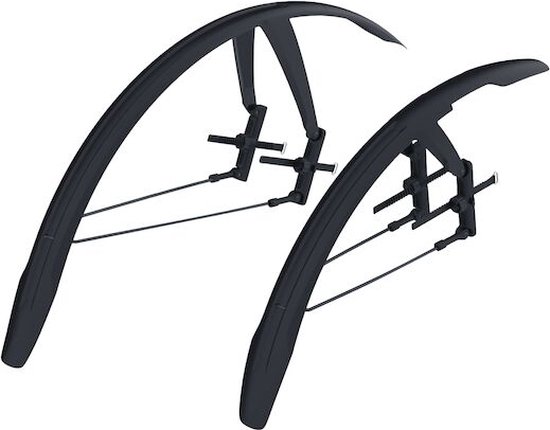
A portable, adjustable mudguard set listed for road bikes and mountain bikes. You fit it on wet days and take it off again.
What you get
- Mudguard set
- Adjustable
- For road and MTB
Why mudguards?
On a wet road your front tyre throws a fan of water up at your shoes, feet and face. Your rear tyre sprays a stripe up your back and onto whoever rides behind you. Good mudguards stop most of it.
Mudguards protect your bike too. Dirt and sand thrown up end up in the chain, brakes and bearings. A drier, cleaner bike wears more slowly and needs less maintenance.
There are three main families. Full fixed guards, bolted to eyelets on your frame, give the best coverage, feet included, but you need mounting points and enough tyre clearance. Clip-on guards are lighter and fit and come off without tools. Short MTB guards mostly keep mud spray out of your face.
The drawbacks are weight, the chance of rubbing, and a different look. A pair of fixed guards weighs roughly 250 to 500 g. Clip-on guards often weigh around 100 to 200 g.
The types of mudguard
The choice depends on your bike and how much coverage you want.
| Type | Coverage | Fitting | Weight per set |
|---|---|---|---|
| Full fixed | High, feet and back included | Needs frame and fork eyelets | About 250 to 500 g |
| Clip-on (road) | Medium, mainly rear wheel and back | Tool-free, straps | About 100 to 200 g |
| Short MTB guard | Low, keeps face and chest clean | On fork crown or seatpost | About 50 to 150 g |
| Mid-length gravel guard | Medium to high, wide tyres | Eyelets or clamp, depending on model | About 150 to 300 g |
Weights are rough guides and vary by model and size.
Choose it if
- You ride in the rain now and then and do not want fixed mudguards.
- Your bike has no mudguard mounts.
- You ride in wet weather too, in autumn and winter or on soggy forest paths.
- You commute or ride in ordinary clothes and want to arrive dry.
Choose something else if
- For daily use in poor weather, fixed mudguards give better coverage.
- You only ride in dry weather and want the lightest bike possible.
- Your bike has little tyre clearance. A mudguard would not fit or would rub.
How to fit mudguards
Measure tyre width and clearance
Pick a mudguard roughly 5 to 10 mm wider than your tyre. Check there is enough room between tyre and frame for the guard.
Attach to eyelets or with straps
Fixed guards attach to the eyelets on frame and fork. Clip-on guards fasten with straps or a clamp, no drilling needed.
Centre over the tyre
Spin the wheel and check the gap between tyre and guard is even all round. A gap of about 10 to 15 mm keeps noise and rubbing down.
Tighten the stays
Tighten the stay bolts and trim any protruding ends. Check nothing can poke into the brakes or spokes.
Test on a short ride
Take a short ride on a wet or dusty road. If you hear rattling or rubbing, adjust the stays.
Good to know
- Check tyre width and clearance under your frame or fork.
- Sizes and mounting method are not in the title.
- After fitting, check there is at least roughly 5 mm of clearance between tyre and guard, and more in mud or gravel.
- On gravel and in the woods, mud can pack between tyre and guard. More clearance prevents the wheel from locking.
- Clip-on and short guards work well but protect your feet and chain less than fixed ones.
- Check regularly that all bolts and straps are still tight. A loose guard can end up in your spokes.
Also in this category
- Spatbordset MTB, verstelbaar voor en achter2 shops · Amazon.nl, Amazon.com.befrom €9.99
- BBB Cycling RoadCatcher achterspatbord1 shop · bol€21.95
- Zefal Trail 65 spatbordset2 shops · Amazon.nl, Amazon.com.befrom €12.99
- Gewage spatbordset voor race en gravel 700C2 shops · Amazon.nl, Amazon.com.befrom €27.19
- BBB Cycling DiscGuard spatbordset1 shop · bol€47.24
- Hotype spatborden voor en achter2 shops · Amazon.nl, Amazon.com.befrom €8.99