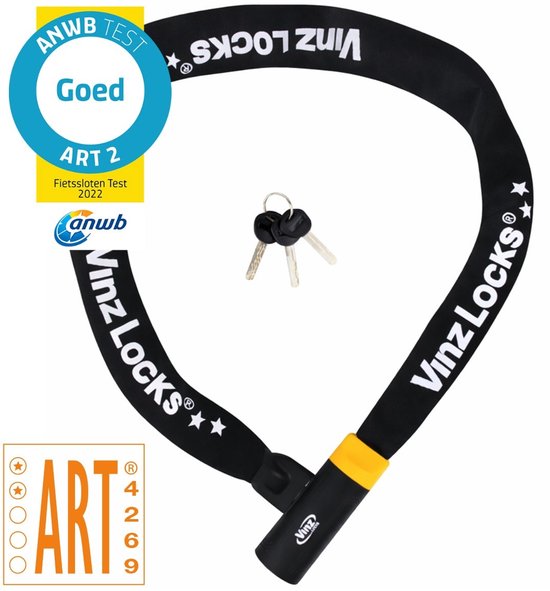
Bike locks
SPGOOD kettingslot 90 cm
This SPGOOD lock is a 90 cm chain lock with 6 mm links. It comes with 3 keys and is black.
What you get
- 90 cm chain lock
- 6 mm links
- 3 keys, black finish
Why a good lock?
No lock is unbreakable. The aim is for your bike to take more effort than the one next to it. Thieves usually pick the easiest target, so a sturdy lock matters most where your bike stands for hours, such as a station or town centre.
The weakest part sets the security. A thick lock with a flimsy hinge or a weak lock body protects little. Check the cylinder, the hinges and how the lock sits around whatever it is securing.
A proven yardstick is the ART certification. It is a Dutch label that grades locks in stars. You mostly see ART 2 to ART 4: the higher the level, the longer a lock stands up to tools. ART 2 suits an everyday bike, ART 3 a pricier one, and ART 4 a valuable or electric bike parked in risky spots. Many insurers ask for a minimum level, so check your policy.
Security and weight go hand in hand. An ART 4 lock often weighs about 1.5 to 3 kg or more. A cable lock weighs roughly 200 to 500 g, but bolt cutters get through it quickly. Choose the heaviest lock you are still happy to carry, because a lock left at home protects nothing.
The types of bike lock
Weight and security pull against each other. Here is what each type offers.
| Type | Weight | Security | Handy for |
|---|---|---|---|
| Cable lock | About 200 to 500 g | Low, bolt cutters cut it | Short stops, second lock |
| Chain lock | About 1.5 to 4 kg | High with thick links (ART 3 to 4) | Long parking, wide fixtures |
| U-lock | About 1 to 2 kg | High (ART 2 to 4) | Daily city use |
| Folding lock | About 1 to 2 kg | Medium to high (ART 2 to 3) | Compact to carry, long reach |
Weights and levels differ per model. Check the ART level on the packaging.
Choose it if
- You want to secure your bike to a post or rack with a flexible lock
- You share the lock and need several keys
- You regularly leave your bike outside, on the street, at a station or at work.
- Your bike is worth more than a few tens of euros and you do not want to lose it.
Choose something else if
- You leave the bike on the street overnight in a busy city: choose a heavier lock
- You ride mostly for sport and stop briefly at a café. A light lock you keep in sight may then be enough.
- You never leave your bike unattended. A heavy lock is then unnecessary.
How to use a bike lock
Choose a fixed point
Use a sturdy post, rack or anchor that cannot be cut or lifted away. A thin railing or a loose object makes a poor anchor.
Lock frame and rear wheel
Pass the lock through the frame and rear wheel, then around the fixed point. That leaves a thief little room for a crowbar or jack.
Keep the lock high and tight
Do not let the lock rest on the ground and leave as little slack as you can. That makes bolt cutters and jacks less effective.
Take loose parts with you
Quick-release wheels, saddle, lights and an e-bike battery can disappear. Take them along or secure them with a second lock.
Look after the cylinder
Put a drop of lock oil in the cylinder every now and then, especially in winter. The key turns smoothly and the lock does not freeze up.
Good to know
- A 6 mm chain is light, so treat it as a lock for short stops
- Check that 90 cm is long enough to link frame, wheel and post
- Always keep your spare key and the lock code card somewhere safe, never on the bike.
- Check that the shackle is wide enough for your frame and a fixed point. A shackle that is too narrow will not fit round a wide post.
- Even a good lock protects less in an area where bikes are often stolen. Park where it is busy and well lit.
- Check that your insurance recognises the lock. Some policies require a certain ART level for theft outside the home.
Also in this category
- Grifema GA1201-12 kettingslot2 shops · Amazon.nl, Amazon.com.befrom €11.99
- Vinz Ventoux kettingslot1 shop · bol€17.95
- Grifema GAK1201-9 kettingslot2 shops · Amazon.nl, Amazon.com.befrom €9.99
- AXA Absolute 9-110 kettingslot1 shop · bol€39.99
- SPGOOD kabelslot 120 cm2 shops · Amazon.nl, Amazon.com.befrom €7.99
- Vinz Salado kettingslot ART 2 120 cm1 shop · bol€17.95