Power meters
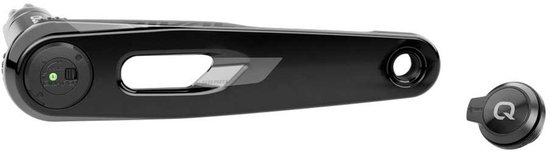
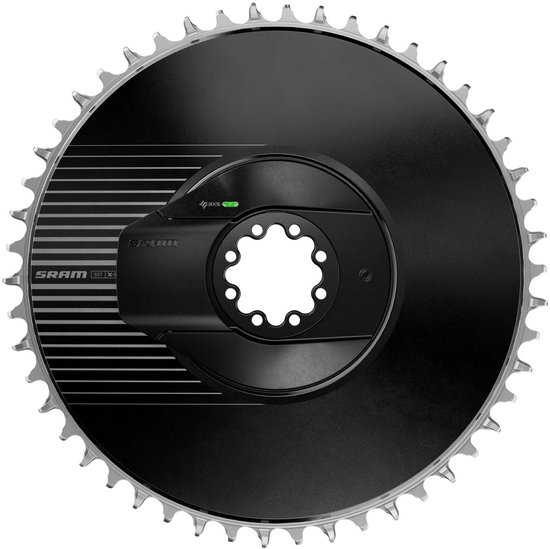
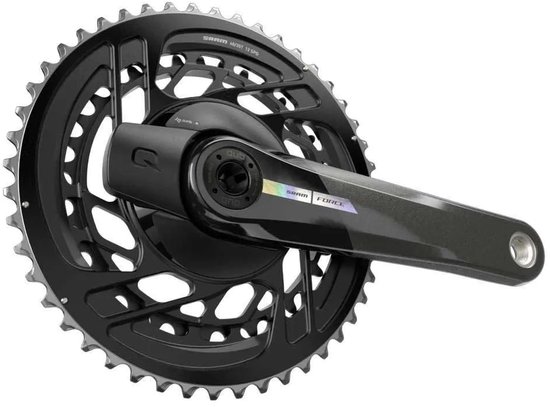
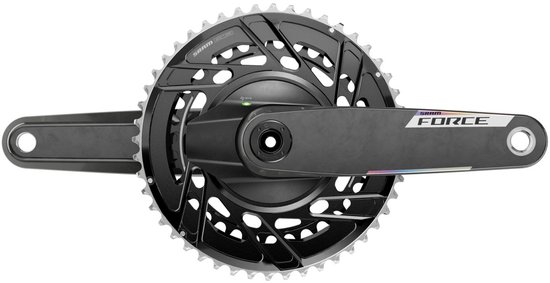
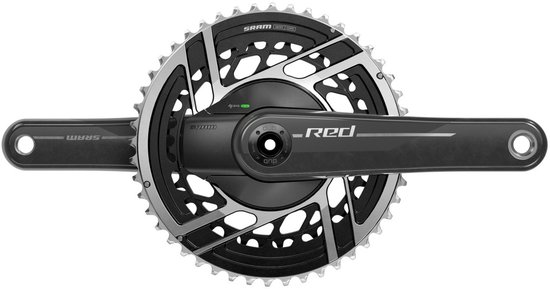
SRAM Red AXS DUB crankstel met powermeter 12-voudig
This SRAM Red AXS DUB crankset pairs 12 speeds with a power meter, in silver with 165 mm arms. The tooth combination is 46/33.
What you get
- 165 mm crank arms
- 46/33 teeth
- 12-speed, with power meter
Why a power meter?
Heart rate reacts slowly and depends on sleep, heat and caffeine. Speed depends on wind and gradient. Power depends on none of those: 250 watts is 250 watts, uphill, downhill or into the wind. That lets you steer intervals, pacing and effort so precisely that your sessions become comparable.
A good power meter measures with strain gauges that sense how the metal flexes as you pedal. Accuracy is typically between 1 and 2 percent, which is enough for training and pacing. Mind the difference between single-sided and dual-sided. A meter that only measures the left side doubles that figure. That is right as long as both legs contribute equally, and almost nobody is perfectly even.
The location sets the price, weight and convenience. Pedals are easy to move between bikes. A crank or crank arm measures steadily and is easy to fit, but stays on one bike. A hub measures the total at the rear wheel and works with any crank, but stays with that wheel. A spider, the star between the crank and the chainrings, measures both legs together and is often considered very stable.
A power meter says little without context. You need to zero it, pair it with a computer and spend some time learning your own zones, for instance with an FTP test, the power you can hold for roughly an hour.
How the meter location compares
Most meters reach 1 to 2 percent accuracy. The location mainly decides convenience.
| Location | Measures | Advantage | Drawback | Swapping |
|---|---|---|---|---|
| Pedals | Left and right separately | Easy to swap, per-leg data | Cleat and pedal type fixed | Very easy |
| Crank arm or crank | Left, or left and right | Stable and light, often well priced | Stays on one bike, standard must fit | Moderate |
| Spider | Total, both legs together | Very stable, matches its own crank | Often higher cost, needs the right crank | Moderate |
| Hub | Total at the rear wheel | Works with any crank and cleat | Tied to that wheel, also on rollers | By swapping the wheel |
Accuracy is typically 1 to 2 percent, but varies by model and conditions.
Choose it if
- You want a compact 46/33 with short 165 mm arms
- You want power measurement in a crankset with DUB axle
- You train in a structured way, with zones, intervals or a plan.
- You want to control your pacing in wind, on hills or in a race.
Choose something else if
- You have longer legs and would prefer a longer crank length
- You ride mostly for fun and speed and feel are enough for you.
- You do not want to analyse numbers and would rather just ride.
How to use a power meter
Fit it as instructed
Use the prescribed torque. A fitting that is too loose or too tight gives wrong readings.
Pair with your computer
Turn the crank a few times to wake the meter and search for it over ANT+ or Bluetooth on your computer.
Zero it
Do a zero offset before every ride, with the crank still and the bike upright. It removes drift caused by temperature.
Learn your zones
Do an FTP test or follow a plan to set your zones. Adjust them as you improve.
Ride and review
During the ride, use the average over a few seconds instead of the raw peak. Look at the full picture afterwards.
Good to know
- Your bottom bracket must be DUB compatible, not included per the title
- The drivetrain must be 12-speed
- Check that the meter fits your crank standard, bottom bracket and cassette or drivetrain.
- Look at the battery type and how long it lasts: a coin cell or a rechargeable battery, usually tens to hundreds of hours per charge or set.
- A left-only meter estimates the right leg. If one side is weaker, the figure drifts away from the truth.
- A new crank, chainring or shifter can call for a new calibration. Follow the manual.
Also in this category
- SRAM Rival E1 AXS DUB linker crankarm met powermeter 172,5 mm1 shop · bol€167.99
- ThinkRider PP5 carbon powermeter1 shop · Amazon.com.be€65.00
- SRAM Red E1 AXS kettingblad met powermeter 48/35T1 shop · bol€778.76
- Geoid PM500 powermeter crankstel1 shop · Amazon.nl€179.99
- SRAM Force AXS DUB crankstel met powermeter 175 mm1 shop · bol€692.11
- SRAM Force AXS E1 DUB crankstel met powermeter 165 mm1 shop · bol€806.53