Seatposts
Zadelpen 27,2/30,9/31,6 mm
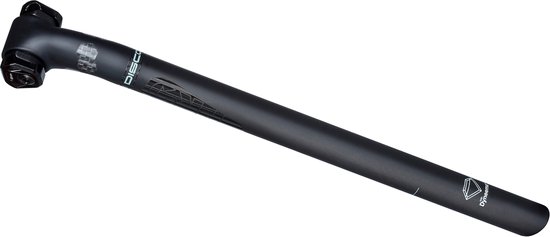
This seatpost is offered in 27.2, 30.9 and 31.6 mm diameters, in 350 or 400 mm lengths. One listing covers the three most common seat tube sizes.
What you get
- Diameters 27.2, 30.9 and 31.6 mm
- Length 350 or 400 mm
Why a new seatpost?
A seatpost looks like a plain tube, but it does three things. It sets your saddle height, its setback decides how far back your saddle sits, and it absorbs some of the road vibration. If you want a different height or position, or to replace a worn or bent post, that is often all you need.
The most important thing is the diameter. It has to match the outside of the post and the inside of the seat tube. Common sizes are 27.2 mm, 30.9 mm and 31.6 mm, and 25.4 mm, 28.6 mm and 34.9 mm also occur. Measure your old post with a calliper, or read the size engraved on it. A post that is 0.2 mm too thin already slips.
Setback is the distance between the centre of the tube and the centre of the saddle clamp. It usually runs from 0 mm (a straight post) to about 25 mm. More setback puts you further behind the bottom bracket, which suits longer legs or a more relaxed position. It also changes how far you can slide the saddle on the rails.
Aluminium is the usual choice: sturdy, easy to fit and typically 200 to 300 g. Carbon is lighter, often 150 to 250 g, and damps small vibrations a little better. It needs more care: overtightening can damage it, and carbon paste is the best way to get grip. A dropper post is meant for mountain bikers.
How seatposts compare
The material and design decide weight, comfort and upkeep.
| Type | Weight | Comfort | Watch for |
|---|---|---|---|
| Aluminium | About 200 to 300 g | Stiff, little damping | Grease against seizing |
| Carbon | About 150 to 250 g | Damps small vibrations a bit better | Carbon paste, low torque |
| With setback (up to about 25 mm) | Same as the straight version | Saddle further back | Choose by saddle position |
| Dropper (telescopic) | About 400 to 600 g | Saddle drops on descents | Insertion length and remote type |
Weights are guides and vary by model and length.
Choose it if
- You need a post that matches your seat tube exactly
- You want to choose between a shorter and a longer post
- You know the diameter of your seat tube and want a post in that size.
- You want to move your saddle further back or forward than it goes now.
Choose something else if
- Your frame needs internal routing or a dropper post
- You are not sure of the diameter. Measure first, because a wrong size never fits well.
- Your frame is carbon and you do not know if a shim is allowed. Ask the manufacturer first.
How to fit a seatpost
Measure the diameter
Measure the old post with a calliper or read the engraved size. Note the length and setback too.
Clean the seat tube
Remove old grease and dirt from the tube. Apply a thin layer of grease to aluminium or steel, or a little carbon paste to carbon.
Slide the post in
Push the post in so far that the minimum insertion mark is not visible. It must stay hidden.
Set the height and direction
Point the saddle straight ahead and choose the height. Tighten the seat clamp.
Tighten with a torque wrench
Use the value printed on the post or the clamp. It usually sits around 5 to 8 Nm, often lower for carbon.
Good to know
- Measure the inner diameter of your seat tube before ordering and pick the matching version
- Check the minimum insertion depth for the length you choose
- Never tighten more than the value on the part. On carbon, the post or frame can crack under too much force.
- A post seized in the tube by corrosion is hard to get out. Remove and grease it a few times a year.
- A shim to fit a thinner post in a wider tube is possible, but ask first whether your frame allows it.
- After a crash, check that the post is not cracked or bent, especially on carbon.
Also in this category
- Roadnado carbon zadelpen1 shop · Amazon.com.be€37.00
- BBB Cycling ElitePost zadelpen 31,6 mm1 shop · bol€49.95
- Ultralichte carbon zadelpen 27,2/31,6 mm1 shop · Amazon.nl€22.69
- Carbon zadelpen 27,2 mm voor race en MTB1 shop · Amazon.com.be€32.42
- Carbon zadelpen 27,2 mm, lengte 350 mm1 shop · Amazon.com.be€28.74
- Pro Discover zadelpen carbon 27,2 mm1 shop · bol€283.70