Cranksets
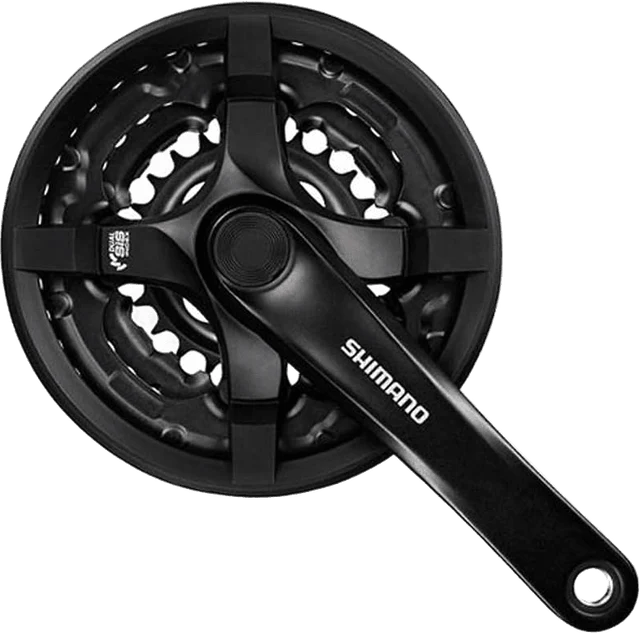
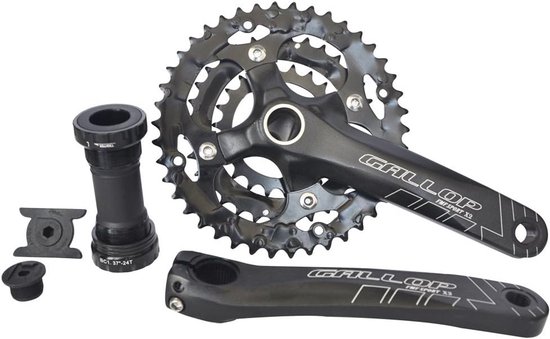
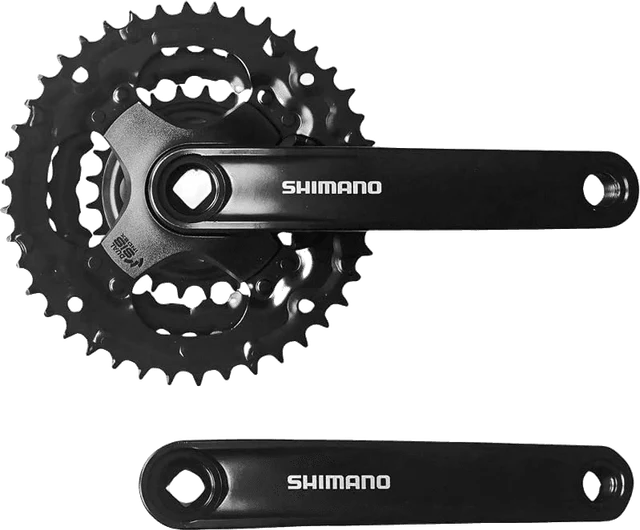
ZTZ MTB-crankstel 170 mm
The ZTZ mountain bike crankset has 170 mm arms and a 104 BCD pattern, with chainring options of 32, 34, 36 and 38 teeth. The title does not state the axle or bottom bracket standard.
What you get
- ZTZ MTB crankset
- 170 mm crank arms
- 104 BCD
- 32/34/36/38T chainrings
Why the right crankset?
The number of teeth on your chainring decides how hard or easy your gears are. A standard crankset (for example 53/39) is made for fast, flat riding. A compact (for example 50/34) gives an easier climbing gear and suits most recreational riders better. On gravel you see 46/30 or 48/31, on MTB often a single ring of 30 to 36 teeth.
A single ring (1x) is simpler: no front derailleur, less weight and less chance of the chain dropping. The cost is bigger jumps between gears and a bigger cassette. Two rings (2x) give smaller steps and a wider total range.
When choosing, look at the BCD, the diameter of the circle on which the chainring bolts sit. On the road that is often 110 mm (four bolts, compact and standard) or 130 mm. On MTB 104 mm is common. The BCD decides which chainrings fit, and so how small or large you can go.
A second choice is the spindle. An old square taper spindle sits in many older bikes. Modern cranksets have external bearings with a 24 mm spindle, or 28.99 mm for SRAM DUB. That is stiffer, lighter and easier to maintain, but it only fits the right bottom bracket.
How the setups compare
The chainring combination decides what your bike is good at.
| Setup | Chainrings | Suits | Downside |
|---|---|---|---|
| Standard | 53/39 or 52/36 | Fast, flat, racing | A hard easiest gear |
| Compact | 50/34 | Hilly and recreational | Less top speed on long descents |
| Gravel 2x | 46/30, 48/31 or 48/32 | Gravel and road, wide range | Needs a front derailleur |
| Gravel 1x | One ring of 38 to 44 teeth | Gravel, simple and sturdy | Bigger jumps, wider cassette |
| MTB 1x | One ring of 28 to 36 teeth | Off-road, climbing and descending | On the road: limited top end |
Pair the chainring with a matching cassette or you lose the top or bottom of the range.
Choose it if
- You want a single or double chainring for a recreational MTB
- You want to choose your tooth count
- Your crankset is worn or cracked, or the teeth have turned hook-shaped.
- You want easier gears for the mountains or harder ones for fast riding.
Choose something else if
- You want a known-brand crankset with a stated axle standard
- You do not know your bottom bracket or bearing type. Without that, you can easily order a crankset that does not fit.
- You only want to replace the chainring: buy the ring separately, provided the BCD matches.
How to fit a crankset
Check the bottom bracket
Look at the width (68 or 73 mm) and bearing type of your bottom bracket. The crankset has to match.
Remove the old crank
Undo the crank bolt or the clamp with a hex key and pull the arm off with a crank puller.
Grease the spindle and slide the crank on
Grease the spindle lightly. Push the right arm with the chainrings through the bottom bracket and fit the left arm on the other side.
Tighten to the right torque
Tighten the bolts to the manufacturer’s figure, usually 12 to 15 Nm. Check after the first ride that everything is still tight.
Adjust the front derailleur
With two rings, reset the height and limit screws on the front derailleur. Finally turn the pedals and run through the gears.
Good to know
- Check the bottom bracket type and axle length
- Check the chain and derailleur that go with it
- Check the crank arm length. You normally ride 170 to 175 mm. A different length changes pedalling geometry, especially with shorter legs or knee problems.
- Use the right adapters and bearings. A BB30 or PF30 bottom bracket needs a different spindle than a Shimano bearing in a standard shell.
- Worn teeth stop a new chain from engaging well. Replace chainring, chain and cassette together where you can.
- Do not overtighten bolts on carbon cranks: follow the stated torque.
Also in this category
- Shimano FC-TY301 crankstel 6/7/8-voudig1 shop · Amazon.nl€22.99
- Shimano FC-TY501 crankstel 6/7/8-voudig1 shop · Amazon.com.be€26.99
- Crankstel met trapas 8/9-voudig1 shop · bol€153.93
- Vervangend crankstel van koolstofstaal1 shop · Amazon.nl€13.99
- Shimano FC-TY301 crankstel 42-34-241 shop · Amazon.com.be€31.38
- Linker crankarm 170 mm1 shop · bol€40.01